ARTICLE
Ensō — What a Circle Drawn in One Stroke Shows
2026-08-28
The Circle Is a Question, Not an Answer
Ensō. A plain circle, drawn with one turn of the brush, sometimes two. Zen has poured everything into this single stroke — enlightenment, the universe, emptiness, the fullness and waning of the moon. Yet I have never drawn an ensō as an answer. Every time one finishes, it feels less like a mark that settled something and more like a question held out toward the viewer. It looks closed, and yet it stays somehow open. Holding both of those at once is the whole of this stroke.
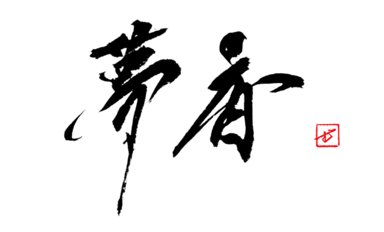
Ensō left on old temple scrolls often carry a short line of words beside them, because the circle alone fixes no meaning. Depending on who looks, it becomes a full moon, a plate, a zero, or infinity. The one who draws it does not lock the meaning down. That posture — leaving it open for the receiver — is close to the mind I bring to the single character mu. Close mu into "nothing there" and the line goes thin. The circle is the same: the moment you decide what it means, it becomes just a round shape.
In One Stroke, Start and End Meet
To draw an ensō I turn it in one breath on a half-hansetsu sheet (35 × 68 cm) with a thick mixed-hair brush. I start from the upper right, sweep clockwise once around, and come back near where I began. That "coming back" takes barely two seconds. It is fast — not because speed is the point, but because a moment of hesitation turns the circle into an egg, so I move fast to leave no room to hesitate.
The hard part is that the instant you try to close it neatly, the line dies. Aim to snap start and end together and the hand begins checking its own answer, and a line that checks itself always stiffens. So I offset the start and end on purpose. I leave the circle unclosed — a faint gap, a seam. That opening lets the circle breathe. As I wrote in the power of a single line, a line lives not when it is perfectly resolved but when it carries a little lack, and the ensō's seam is where that lack shows most plainly.
The Seam Shows Who You Were That Day
I grind blue-black ink with the faint smell of the glue rising, steady one breath over the steaming inkstone, and then face the circle. On a good day the offset between start and end sits just right, the line thickens and thins on its own as it turns, and a single thread of dry-brush scrape opens near the lower right, letting time flow through it. On a bad day the strain shows in the seam: a hand rushing to close pools the ink at the very end, and that one spot hardens black — the face of a circle holding its breath.
I once tried deciding the words first and drawing the circle to fit them. Holding "this is a full-moon circle," my hand kept tuning to that meaning, and the circle turned into an explanation. An explaining circle is dull to look at. In the end I chose the sheet where I let the meaning go and simply turned one careful round. Like what empty space says, the white inside the circle — the space where nothing is drawn — is the most eloquent part of an ensō.
An ensō is not finished when you lift the brush. It closes only when a viewer sets something of their own inside it. What I leave is one question, with a seam that never fully closes. Well — what do you see in this circle? A stroke that can hold that out is one I am still turning.