ARTICLE
Mu — Why a Single Character Takes the Longest to Write
2026-07-23
What the Single Character Mu Points To
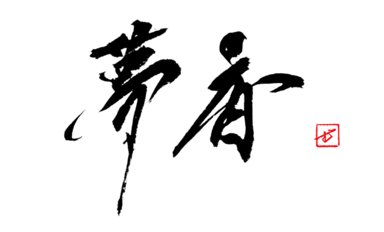
The one character 無, mu, does not simply mean "nothing." The reason Zen treats it with such weight comes from the first case of the koan collection Mumonkan: Master Zhaozhou's "Mu." A monk asked whether a dog has Buddha-nature or not — does it have it, or has it not? — and Zhaozhou answered with a single word: 無. Not "has," not "has-not." With one character he turned back the very question. Mu is what stands before the split of has and has-not.
So I do not write this character to mean "empty" or "there is nothing." I am not depicting a state of lack. I am trying to stand in the place before things are counted as present or absent, before they have divided at all. I want to set down a line that stops just short of meaning — not a line that explains the word.
A One-Character Work Is Subtraction, Not Addition
People assume fewer characters must be easier. It is the opposite. When you place a single character on a half-sheet — 35 by 68 centimeters of white paper — there is nowhere to hide. In a many-character piece a bad stroke dissolves into the whole; in a one-character work, one stroke is the life or death of the piece. What I watch most in single-character work is not adding but subtracting. The more I write, the more I try to strip from the line — surplus tension, surplus speed, the "good shape" my hand has memorized.
Mu is twelve strokes. The four dots along the bottom, the rekka fire-radical (灬), are the trap: try to align them and place each one carefully, and the line turns talkative, explanatory. The instant those four become four separate, well-made dots, the character reads as "someone drawing nothing very diligently." So I sweep the four as one breath continuous with the horizontal above, almost without counting them. I grind blue-black ink, aoboku, a little thin, pulling back the sheer push of pure black — because writing Mu in dense black lets the blackness itself assert "there is something here." While I grind, the slightly heavy scent of animal glue fills the room and my knees go numb in seiza. When I can stop counting even that numbness, the line comes out lightest.
The Day I Missed Mu
I once failed badly with this character. The horizontals aligned cleanly and I thought, today it's working. That conceit went straight into the final fire-radical. Trying to land the four dots beautifully, force gathered in the brush tip and they came out as four fine, proud grains. As technique, not bad. But what sat on the paper was not Mu — it was "a record of writing the character Mu well." Meant to stand before has and has-not, I had leaned toward the has of "I did this well." Ruined sheets piled on the floor, and that day I never reached the real sheet; I put the ink away.
The next morning I let the force out and stopped counting the four dots. First, erase the self that wants to write well. The alignment of the horizontals loosened a little, but the whole character began to breathe. Mu lies farthest from the hand that tries to write it well. Only what remains after everything is subtracted becomes this character. Grasping that took two days — for a single character.
On turning Zen phrases into lines I've written more in Calligraphy and Zen, and on how to treat the unwritten part in White Is Not Background. In August 2026 my first solo exhibition "Zen" opens at Palette Gallery in Azabu-Juban, Tokyo, and I plan to show this Mu there as a single-character work. August 5 (Wed) – 10 (Mon), admission free. Details on the exhibition page.