ARTICLE
The Art of Ma: How White Space Elevates Japanese Calligraphy
2026-04-01
Introduction — The Power of Not Writing
When you first begin learning calligraphy, your attention naturally gravitates toward the ink — the brushstrokes, the character forms, the flow of black on white. But as your skills develop, a quiet realization emerges:
The parts you don't write shape the work just as much as the parts you do.
As a calligrapher, one of the concepts I hold most dear is "ma" (間) — the beauty of intentional empty space. Just as music needs silence between notes, calligraphy needs breathing room between strokes. It's in these quiet spaces that a piece truly comes alive.
What Is Ma? — The Heart of Japanese Aesthetics
The Concept
Ma is a foundational principle woven throughout Japanese culture. You'll find it in architecture, garden design, music, martial arts, and the tea ceremony. It refers not merely to physical emptiness but to a charged, purposeful pause — space that carries meaning.
In calligraphy, ma is not the leftover area around your characters. It's an active compositional element, equal to — or even more powerful than — the ink itself.
The Chinese calligraphic tradition has long recognized this through the maxim "keihaku tōkoku" (計白当黒): plan the white as you would the black. In other words, design your empty space with the same care you give to your brushstrokes.
Why White Space Matters
Our eyes don't just see characters in isolation. We perceive figure and ground together — a principle well established in Gestalt psychology. In a calligraphy piece, white space serves several critical roles:
- Creates rhythm — Appropriate spacing between characters gives the work a sense of breathing and flow
- Guides the eye — Strategic placement of empty space directs how a viewer reads the piece
- Adds dignity — Generous margins and spacing lend an air of refinement and authority
- Invites imagination — By not saying everything, you invite the viewer to feel and interpret
Types of White Space in Calligraphy
1. Internal Character Space
This is the white space within a single character — the opening inside "口" (mouth), the gap within "門" (gate), the areas between individual strokes. When these internal spaces are even, the character feels stable. When they vary, the character gains movement and energy.
In my own work, I pay close attention to this inner balance. When writing the character "風" (wind), for instance, I sometimes open up the internal space slightly wider than usual, creating a sense of air flowing through the character itself.
2. Character Spacing
The distance between one character and the next. In vertical writing, this is the gap above and below; in horizontal writing, left and right.
- Tight spacing → power, tension, urgency
- Wide spacing → elegance, tranquility, spaciousness
- Varied spacing → rhythm, vitality, musical quality
Study Wang Xizhi's legendary "Preface to the Orchid Pavilion" and you'll notice how the character spacing ebbs and flows like a musical composition.
3. Line Spacing
The space between columns (or rows) of text. This element defines the overall "breathing" of the entire piece. Line spacing that's too narrow feels claustrophobic; too wide, and the work loses cohesion.
When I work on a standard half-sheet (hansetu) format, I typically set line spacing at about 1.2 to 1.5 times the character width — though this is a guideline, not a rule. The content and expressive intent always take priority.
4. Margin Space
The empty space surrounding the entire composition. The top margin is called "ten" (heaven), the bottom "chi" (earth), and the sides simply left and right.
Traditionally, the top margin is kept wider than the bottom, creating a visual balance suited to hanging scroll presentation. In contemporary calligraphy, however, artists are increasingly using bold, unconventional margins — sometimes leaving most of the paper empty with just a small cluster of characters placed off-center.
Practical Techniques for Mastering White Space
Technique 1: See Before You Write
Before you pick up your brush, spend time simply looking at the blank paper. Visualize where each character will sit. Feel the weight and balance of the composition in your mind.
I spend at least a few minutes contemplating the paper before every serious piece. This practice of "tasting the white space" sharpens your sense of composition in ways that no amount of brushwork practice alone can achieve.
Technique 2: Think in Subtraction
Beginners tend to want to fill the paper. But advancing in calligraphy is, in one sense, learning what not to write. It's a process of subtraction rather than addition.
Try this exercise: write the same phrase twice — once with minimal margins and tight spacing, once with generous white space. You'll likely find that the spacious version feels more alive, more refined.
Technique 3: Study the Classics
Historical masterworks are the best textbooks for white space. These are particularly worth studying:
- Kūkai's "Fūshinchō" — Subtle variations in line spacing create a natural, breathing rhythm
- Ryōkan's calligraphy — Generous, warm spaces that mirror his gentle personality
- Ikkyū Sōjun's ink traces — Bold contrast between sweeping white space and powerful brushwork
When viewing these works, pay attention not just to the characters but to the shapes formed by the empty spaces themselves. You'll discover that the white space has its own beauty.
Technique 4: Connect Through Ki
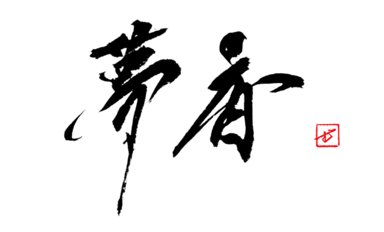
In calligraphy, we speak of "kimyaku" (気脈) — the invisible thread of energy that flows from one character to the next. Even across empty space, this energetic connection can hold a composition together.
The key is to feel the beginning of the next character the moment you finish the current one. Even as your brush lifts from the paper, your spirit is already moving toward what comes next. This inner continuity breathes life into the spaces between characters.
Ma in Contemporary Calligraphy
While honoring the traditional aesthetics of ma, contemporary calligraphy continues to explore new dimensions of white space. Installation art that transforms entire rooms into calligraphic space, fusion with digital media, architectural exhibitions — in all these frontiers, the concept of ma grows ever more relevant.
In my own practice, I always remind myself: white space is not empty — it is full. The unmarked areas of paper carry their own energy, their own presence. When you can feel that truth, your calligraphy deepens immeasurably.
Closing Thoughts — Listen to the Silence
There's a saying in calligraphy: "ichiji senkin" — one character is worth a thousand gold pieces. I'd like to add my own version: "ichihaku senkin" — one space of white is worth a thousand gold pieces too.
The next time you pick up your brush, give as much attention to what you leave empty as to what you fill with ink. Your calligraphy will begin to breathe. Your compositions will come alive with a vitality that ink alone cannot provide.
Within the white space lies infinite possibility. That is the beauty of calligraphy — and of Japanese culture itself.
Calligrapher MUKYO combines traditional techniques with contemporary sensibility to explore new possibilities in the art of sho. For workshops on composition and the aesthetics of space, please feel free to get in touch.