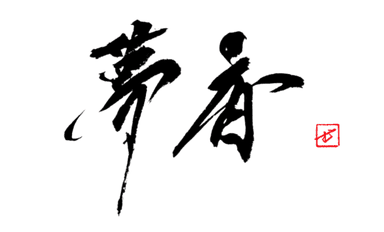
ARTICLE
What a Single Line Can Say — The Power and Life Force of Line in Shodo
2026-05-19
Introduction — A Universe Within a Line
Everyone who studies shodo eventually hits the same wall.
"I can write the characters now. But they look... dead."
I spent years with that feeling. The forms were correct. The strokes followed the model. But looking at the work felt like staring at a printout — technically there, emotionally empty.
I've come to believe that the essence of shodo is not in the characters. It's in the line.
A single line carries the breath of the person who drew it, their hesitation, their commitment. That trace — that physical record of a moment — is what makes a work feel alive. Today I want to talk honestly about the question I've been wrestling with my whole life as a calligrapher: what is a line, and what can it say?
What Is a Line? — A Moment Born Between Ink and Paper
What actually happens when the brush meets the paper?
Ink-soaked bristles cross the surface of the fibers. In less than a tenth of a second, everything is transferred: the weight of the arm, the angle of the wrist, the rhythm of the breath, the tension or release of that exact moment. All of it lands on the page.
A line is a record of the body.
This is what makes shodo fundamentally different from painting or printmaking. A calligraphy line cannot be corrected. Cannot be erased. There is no undo. So the line is honest — almost cruelly honest — about the state of the person who made it.
When you are tense, the line stiffens. When you are relaxed, the line flows. When you are angry, the line breaks and surges. When you are sad, the line thins and trembles.
A line cannot lie. That is the terror and the beauty of shodo.
The Difference Between a "Skilled Line" and a "Living Line"
When you begin studying shodo, you aim for a skilled line.
Bristles aligned, balanced thick-and-thin transitions, clean entry and exit strokes, no wobble. It is genuinely beautiful. And yet, sometimes that kind of line feels suffocating to look at.
What I actually chase is a living line.
A living line has these qualities:
Breath is visible — The line's weight and density shift subtly, as if lungs are filling and emptying inside it.
Speed is felt — The viewer can sense where the brush flew and where it paused, without being told.
Gravity is present — The line was not just slid across paper. The full weight of the arm rode through it.
The ending opens outward — Even after the line stops, something continues. A resonance lingers.
A skilled line can be taught. A living line cannot come from technique alone. That is shodo's difficulty, and its depth.
What Can One Line Express?
I've been running an ongoing experiment: can a single line express three-dimensional form?
Not writing a character — just drawing one line. It curves, thickens, thins, drags, and returns. Can that alone make a viewer feel something?
The answer is yes.
Consider tracing a mountain ridgeline in a single stroke. The brush rises slowly from base to peak, pauses briefly at the summit, then descends. That alone carries the weight of the climb and the relief of the view from the top.
The legendary Japanese calligrapher Yuichi Inoue, in his final years, wrote almost exclusively a single horizontal stroke — the character "一" (one). These were monumental works, pulled with the full body. Standing in front of them, people go quiet. Why?
Because the line is alive.
My Methods for Drawing a Living Line
There are limits to what can be taught technically, but here is what I actually practice.
Feel the Line Before Drawing It
Before picking up the brush, I trace the line through the air — at the actual speed and pressure I intend to use. This is not rehearsal. It is dialogue with the line itself.
By the time the brush meets the paper, the line has already begun.
Don't Hold Your Breath
Most people freeze at the critical moment. Trying to concentrate, they brace their body and the line dies.
I breathe deliberately while writing. When drawing a long line, I synchronize the motion with an exhale — the line extends as the breath releases. This alone changes the nature of what comes out.
Attend to the Ending
Many calligraphers focus intensely on how a line begins. I focus equally on how it ends.
The moment the brush lifts from the paper. What remains. Does the line continue somehow in the air after the ink stops?
A line that ends vaguely looks unstable. A line that ends with intention — even if it fades into a dry scrape — looks composed. That resonance left hanging after the brush lifts is exactly what ma, the interval in shodo, means: the line has stopped, but the interval continues. The ending is not finishing. It is a kind of silence.
Write the Failure
This may be the most important one.
The moment you try too hard to write well, the line dies. The desire for perfection stiffens the body, shallows the breath, and pulls life out of the stroke.
When you accept that failure is possible — when you are truly focused rather than merely careful — the line suddenly comes alive. This cannot be controlled. It happens through a kind of release.
A concrete example. One morning I was writing the single character 道 (michi, "the way") on half a hanshi sheet, 35 by 68 centimeters. I had ground the blue ink dark, and after ten sheets the first vertical stroke was still stiff — the tip too perfectly aligned, the line like something printed. On the eleventh sheet, ready to throw it away, I let the tension go, and the base of the brush caught the paper and the ink ran out mid-stroke. Kasure — the dry scrape. Normally I would discard a sheet like that. But that one broken vertical was breathing more than any line I'd drawn all morning. The friction of brush truly meeting paper had stayed inside the stroke as speed. A dry scrape is not always a shortage of ink; sometimes it is proof that brush and paper met in earnest — as I wrote in the aesthetics of kasure, I stopped fearing it after that morning. You cannot aim for it, but when it comes, don't kill it. Before discarding a sheet, I look once at only this: is the line breathing?
The Possibility of "Line" in Contemporary Practice
Throughout shodo's history, the line was always a means to an end: writing characters. But contemporary calligraphers are beginning to treat the line itself as the subject.
Stripped of the armor of linguistic meaning, a line speaks more directly. The body responds before the mind decodes anything. That is the primal power of line.
Ancient engravings cut into rock. The traces waves leave in sand. The unselfconscious marks a child draws. All of these are "alive" before they mean anything.
That is where I am trying to go: a line that simply exists, beyond technique, before meaning.
When someone stands before a framed work, I want the line to reach them before they read a single character. Something language can't quite say — I want the line to say it first.
Closing — Returning to the Line
Long study of shodo eventually leads you back to something simple.
You accumulate classical forms, complex scripts, theories of composition — and somewhere in the middle of all that, you realize: what you actually want to face is far simpler.
One line.
Shodo begins there, and shodo is complete there.
The next time you sit before a blank sheet, before writing any character, try drawing just a single line. Not trying to do it well. Just letting the brush go.
You are in that line.
Calligrapher MUKYO pursues life force over technical perfection. Her works explore the raw expressiveness of the line itself. Follow her latest work on Instagram.