ARTICLE
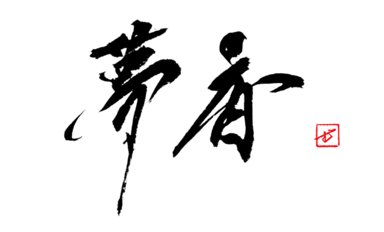
Shikan — What the 'Just' in 'Just Write' Asks You to Drop
2026-08-12
Shikan Lives on the Far Side of Purpose
Shikan (只管) means "single-mindedly," "nothing but that." Zen gives the word its weight through Dogen's shikan taza — "just sitting." Zazen is not treated as a means to enlightenment; the sitting itself is the awakening. Practice and realization are not split apart. You do not sit in order to get something. You just sit. The word stands exactly where purpose has been removed.
Carry it into calligraphy and it becomes "just write." But that "just" is the hardest thing in the room. Writing to improve, writing to be seen, writing to be praised — only after you peel off each in order to, one at a time, does "just write" remain. Shikan is subtraction: the steady removal of purpose from the act of writing. It comes from the same root as the idea that a one-character work is subtraction rather than addition (the character Mu).
Purpose Always Shows in the Line
The trouble is that any purpose left in the hand goes straight into the line. On a morning when I pick up the brush thinking let me get one good shot today, the opening of the stroke braces. At the first point the brush tip goes hunting for a "shape worth showing" and arrives a fraction late. That delay is too faint for anyone but me to feel, yet on a half-sheet of white paper — 35 by 68 centimeters — it reads, afterward, as a real cloudiness. An aimed line carries the weight of its aim.
So I write my first morning copywork on the assumption that I will throw it away. Before facing the real sheet I run dozens of sheets of classical models without counting good or bad. I grind blue-black ink, and somewhere in the faintly heavy scent of animal glue, as my knees go numb in seiza, the self that wants to write well finally thins out. When I can stop counting the numbness, the in order to starts leaving the line. That is really why I keep a daily practice at all (how to build a daily practice). Shikan is not a special mental state; it is the dull repetition of moving the hand until the hand forgets its extra purposes.
After the Exhibition, Back to Just Writing
I recently closed my first solo show, "Zen," at Palette Gallery in Azabu-Juban, Tokyo (August 5–10). During a run like that, "how will this look to whoever comes" gets into the hand whether you want it or not. The day after it closed, facing paper that no one was going to see, my first few sheets were still dragging the gallery's gaze with them — the line kept looking for an audience. Noticing that, I peeled the purposes off again, one by one. Before the show, during it, after it, the work was the same. Return to just writing.
I once got this "just" badly wrong. I mistook "drop your purpose" for "write carelessly, throw it away." Thinking I only had to release tension, I threw out my care along with it. What remained was not a free line but a slovenly one. The "just" in shikan is not slacking. It is writing at full effort while subtracting only the payoff. Write carefully — and for no one. On the rare mornings I can stand on that contradiction, the line comes out light. On turning Zen phrases into lines I've written more in Calligraphy and Zen. Just writing is always the nearest thing, and the farthest.