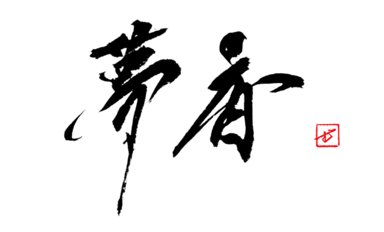
ARTICLE
和 (Wa) — Why the Character for 'Harmony' Holds a Rice Plant and a Mouth
2026-08-22
和 Is a Character About Being in Balance
If you write 和 as if it merely meant "getting along," you miss its core. The left side, 禾, is the shape of a rice plant heavy with grain. The right side, 口, is literally a mouth. Ripened grain carried to the mouth, or shared out and eaten together — harmony sits at that point of balance. We do not soften because we are close; harmony rises only when each portion is properly weighed against the other. So 和 is not a flat state with no opposition. It is 禾 and 口, two different things standing side by side, neither pushing nor pulling, held at exactly the right distance. That stillness kept under tension is what I understand harmony to be. "Peace" and "accord" are not the quiet of emptiness but the quiet that different things make when they come into balance. Calligraphy is the same: dark ink and white washi, thick line and thin, when their differences are balanced, harmony appears on the sheet.
Building the Eight Strokes (禾 and 口)
和 has eight strokes: five for 禾 on the left, three for 口 on the right. The left is large and the right small, yet the two sides must read as near equals — that is the difficulty. For the rice radical, set a short down-left sweep, run one horizontal, then bring the vertical down, placing a short sweep and a dot on either side to make the shape of the grain-heavy plant. I tilt that vertical a hair inward — to the right — rather than standing it perfectly upright, because a truly vertical stroke pushes the 口 away. The 口 is three strokes: the left vertical, the turn across the top and down the right in one breath, and the horizontal that closes the bottom. Write it too large and the character bulges right; too small and 禾 crushes it. I set the top of the 口 at roughly the same height as the radical's horizontal, and stop its base a little above where 禾's vertical ends. Match the two centers of gravity in height, and the unequal pair falls, oddly, into balance. The full stroke order lives on the kanji dictionary page for 和.
Don't Let the Two Sides Face Off — Melt Them Into One
The most common failure here is 禾 and 口 glaring at each other like separate faces. I once spent a day writing 和 as a single character to give to someone. Each stroke was tidy, yet on every sheet an invisible wall stood between 禾 and 口, and the character split down the middle. After more than twenty discarded sheets I saw that I had not carried the breath of the radical's final dot into the entry of the mouth on the right. The brush leaves the paper as it crosses from 禾 to 口 — but if the feeling leaves too, the two sides become strangers. Write as if an invisible line joins the end of 禾 to the start of 口, and the unequal pair finally melts into one word.
和 is not a character that erases difference to make one thing; it balances things while they stay different. So I don't try to make the two sides the same size. 禾 stays large as 禾, 口 stays small as 口 — I match only the height of their centers. Balancing difference while keeping it: that breath runs straight through the zen phrase wakei seijaku. On the groundwork of balancing a line, I've written how to write kanji beautifully. Tilt the radical's vertical a hair to the right, set the mouth's center at the same height as 禾 — and your 和 will stop splitting, and begin to settle, different yet one.