ARTICLE
Kanji 和 (Wa): Three Readings, One Root
2026-11-04
Three Readings, One Root
和 has three voices in Japanese: the on-reading wa (平和, peace; 調和, accord; 和食, Japanese food), and the kun-readings yawaragu (to soften, to ease) and nagomu (to settle into calm). They feel subtly different. Wa names the concept from the outside; yawaragu is the moment of softening, something hard beginning to yield; nagomu is the whole room relaxing, an atmosphere rather than an event.
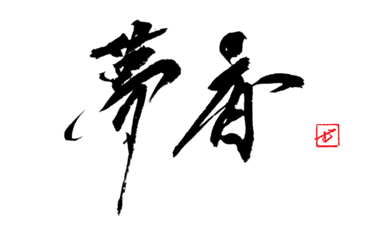
Standing at my desk each morning with ink on the stone, I sometimes write this character and read the three aloud in sequence. Yawaragu — nagomu — wa. When I do, the brushstrokes seem to shift with each. With yawaragu in mind, the left-side sweep releases; with nagomu, the final stroke settles quietly. This is not a technique I read about. It accumulated over years of practice, without my noticing when.
禾 and 口: Why Rice and a Mouth Make Harmony
The left component of 和, the radical 禾, is the shape of a rice plant bowing under the weight of its grain. The right side, 口, is a mouth. Ripe grain brought to the mouth — or distributed and eaten together — that act of sharing is the character's original scene. For the larger story of how pictographs became the standard script we write today, from pictograph to standard script covers the transition.
From that origin, all three readings branch naturally. The grain is shared, so things yawaragu — ease. The table settles, so the room nagom-u — calms. The larger concept, wa, is the state that sharing makes possible. Three readings, one root.
大和 (Yamato), the ancient name for Japan, draws on this same character. A country whose life centered on rice cultivation found in 和 a word for its own character. 和食, 和室, 和服 — the prefix meaning "in the Japanese style" — all trace back to that same origin.
Writing the Character
和 has eight strokes: five for 禾 on the left, three for 口 on the right. The left is larger than the right, yet both sides must read as equals — that is the central difficulty.
The mistake I made earliest was letting my attention drop when I lifted the brush after 禾's final dot. That brief moment in the air between the two components was where I lost the thread. When 禾 and 口 are written as separate events, an invisible wall forms between them. I now write as if one continuous line connects the end of 禾 to the opening of 口, even though the brush never touches the paper between them. The specific mechanics of all eight strokes are in writing 和 — where 禾 and 口 meet.
Three readings, one character, one root. 禾 and 口 together hold the whole range from individual ease to cultural identity — and the brush, moving between them without breaking, holds it all in one motion.