ARTICLE
The Reading and Origin of 仙 (Sen) — How One Character Became the Root of Sennin, Senkyō, and Sendai
2026-09-30
Where the Reading 'Sen' Comes From
仙 has one reading: sen. There is no kun reading — this character, built only from a person and a mountain, arrived with no native Japanese reading. The on-reading sen traces to ancient Chinese xiān, and the meaning traveled with it. Meaning and reading both came from the same direction: over the mountains.
The first time this character stopped me was outside a calligraphy workbook. When I was in middle school, I had an occasion to write the place name Sendai on a sheet of colored paper. Somewhere around the second or third sheet a question surfaced: why does Sendai use this character? My hand paused on the inkstone, grinding ink in slow circles, and the familiar character turned suddenly strange. I still feel the resistance of the inkstick against wet stone, and the way the question opened up while my hand kept moving.
The structure is usually explained as a compound of meaning: 亻, person radical, combined with 山, mountain. A person who goes into the mountain — that is what the character means. The older form, 僊, predates it; 僊 carried a sense of rising high, of something ascending. 仙 settled in as the simplified form. Full stroke-by-stroke structure is in the kanji dictionary entry for 仙.
Sennin, Senkyō, Sendai — When One Character Becomes a Root
Trace the words built on 仙 and the character's world comes into shape. Sennin: a person who enters the mountains, cultivates life force, and grows beyond aging. Senkyō: the place such a person lives — a realm sealed off from ordinary existence, a Peach Blossom Spring. Both words carry exactly what is already in the character: a place half a step outside where we are.
The city name Sendai follows the same logic. The original castle was called Chidai-jō; it was later renamed Sendai-jō, Sendai Castle. That character, 仙, echoes a phrase from classical Chinese poetry — a high place where immortals gather. That a castle town in the mountains of northeastern Japan took on a character meaning a mountain sage's dwelling does not feel like accident to me. I cannot confirm it as the conscious intention of whoever chose it, but writing Sendai with this in mind, the three characters hold a little more depth.
仙女 (celestial maiden), 仙人掌 (cactus — literally "a mountain sage's palm"), 八仙花 (hydrangea — "the eight immortals' flower"): in each case, 仙 marks something that lives at a remove from ordinary human life. When a single character carries that much of a web, looking at its shape changes.
What the Brush Feels in Running Script
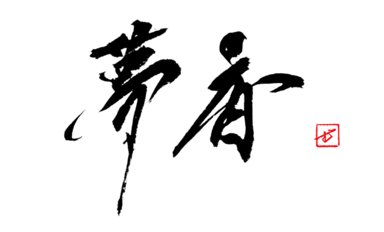
Writing 仙 in regular script — pulling the person radical's vertical taller than the mountain, keeping the mountain narrow and upright, leaving white below — I covered the proportion and spacing in detail in 仙: When a Person Enters the Mountains, They Become an Immortal. In running script, what I track is a different moment: the instant after finishing the person radical's final stroke, before the brush returns to begin the mountain's first.
In that gap — the brush tip lifts from the paper, turns through the air, and comes back down — there is a path that some calligraphers call the line in the air: not drawn on paper, but traced through the wrist. No one can see the road a mountain sage walks from the village into the peaks. The character in running script has the same unseen passage. When I follow that air-line with real intention — conscious of the wrist's arc through the blank between person and mountain — the running script character gains a lightness that the form alone would not give. I did not feel it until well after I could write the character fluently. For the broader structure of how kanji shapes carry meaning, the history of kanji covers this from the beginning.
仙 is a character that came over the mountains — its reading and meaning arrived together. In regular script it is five strokes, clear and direct. In running script, the gap between person and mountain holds an invisible line, and in that line, something of the mountain sage appears.