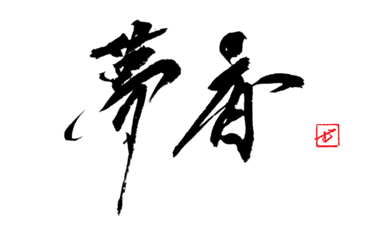
ARTICLE
Kanji 氷 (Hyō / Kōri): The Character That Holds Frozen Water
2026-11-12
Two Readings, Two Ways of Knowing Ice
氷 carries the on-reading hyō and the kun-reading kōri. Hyō enters words like 氷点 (freezing point), 流氷 (drift ice), 氷山 (iceberg) — the vocabulary of meteorology and measurement. It treats ice as a category observed from outside.
Kōri arrives differently. The transparency of an icicle hanging from the eaves. Cold striking the skin when fingers close around a piece of ice. Kōri is what the body encounters before language names it. When I bring kōri into the character rather than hyō, the brush's first stroke settles differently.
Coming to 氷 today, the day after writing 霜, the sequence — 雪, 寒, 霜, 氷 — accumulates in the hands. Writing winter characters in order traces the descent of cold through the body.
The Nisui Radical: Water Made Solid
氷 belongs to the nisui (冫) radical. Where the sanzui (氵) — the three-dot water radical — represents water as liquid and flow, nisui represents water transformed into solid: ice, hardness, the arrest of motion. Characters carrying nisui tend to concern temperature, rigidity, or the changing state of water: 冷 (cold), 凍 (frozen), 凋 (wither).
The older form of 氷 is 冰 — the character 水 (water) with a point inside it, visualizing a solid mass forming within water. Three thousand years of scribes have written this character through winter practice. As 冬 marks the year's closing, 氷 marks water's.
The Two Dots That Set the Character's Expression
氷 has five strokes. The two dot-strokes of the nisui radical stand on the left; the modified 水 structure occupies the right. Described in words, the composition sounds uncomplicated — but once ink meets paper, those two dots determine the character's entire expression.
What I return to most when writing 氷: the angle difference between the two dots. The first is a short, near-horizontal flick; the second, below it, a longer stroke pulling more decisively to the lower right. These two strokes must hold different weights without drifting apart. When they equalize, nisui weakens and its contrast with the 水 component disappears. When they carry their own weights and answer each other, the character holds.
Writing large on a half-sheet (35×68 cm), I pause after the two dots and sit back. Working in seiza, face close to the paper, I read only the brush tip. Distance reading — sitting up after the dots to read the character from across the room before continuing — took many sessions to make automatic. Early failures: pressing too hard on both dots so they collapsed the structure beside them, or barely marking them so they floated. Neither can be fixed after the character is finished. The balance has to be felt before the brush lifts.
What Frozen Mornings Teach
Toward the end of November and into December, mornings arrive when thin ice has formed on puddles outside. Entering the studio, the air is still cold — feet sensing cold rising from the floor before the heater has had time to work. On those mornings the first strokes of grinding ink feel slightly blunted in the fingers.
Writing 氷 in that cold, the character and the season coinciding, I notice ink settling differently into the paper. I cannot explain this precisely: whether the temperature has changed the ink's viscosity, or whether cold hands read the paper's texture differently. What I know is that cold-morning ink moves at a different pace. The studio's conditions are not backdrop; they are part of what appears on the page.
Ink and paper and brush on a November morning. The character holds the cold.