ARTICLE
Kanji 冬 (Fuyu / Tō): The Character That Closes the Year
2026-11-07
Two Readings, Two Temperatures
冬 carries two sets of readings in Japanese: the on-reading tō and the kun-reading fuyu. Tō appears in tōmin (冬眠, hibernation), tōji (冬至, winter solstice), and ettō (越冬, overwintering) — words about inward movement and seasonal boundary. Fuyu is what the body knows: the hardened ground in early morning, the moment breath becomes visible, the difference in temperature between the ink stone's edge and your fingertip.
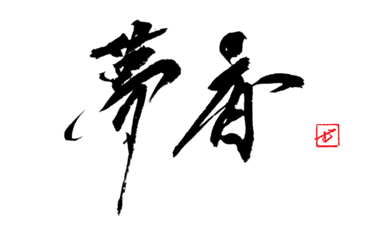
Before writing 冬, I find myself choosing between these sounds. When I carry tō into the character, the strokes tend toward interiority — weight contained. When I carry fuyu, something heavier and quieter settles into the final two dots at the bottom. I do not decide this; it arrived through practice over ten or more years, the sounds and hand movements binding to each other without announcement. Today is Rikkō — the first day of winter in the Japanese calendar. Writing 冬 on this date is a once-yearly coincidence that feels precise.
The Knotted String That Became a Season
Tracing from pictograph to kaisho, 冬's oracle bone form is not a picture of ice or bare trees — it is a string with knots tied at both ends, a sign meaning closure, ending. The character was used for year's end before it came to name the final season itself.
As script styles moved toward kaisho, the bottom portion stabilized into 冫, the two-dot radical associated with frozen water. The modern five-stroke 冬 carries the transformed upper form of that knotted string, with the ice dots below. The original image is no longer readable. But the sense of gathering inward — of things completed and enclosed — is still present in the structure. Among the four seasons written in kanji, 冬 alone moves toward containment rather than expansion. The etymology and the visual form agree.
Two Dots as Counterweight
When writing 冬, the detail I attend to most is the final two strokes — the 冫 component at the base. These dots are not decorative. They function as a counterweight that anchors the entire character from below.
The first dot moves downward to the right; the second falls slightly more inward. If the two do not angle toward each other correctly, the character reads as floating — the upper form ungrounded. Writing 冬 large on a half-sheet at 35×68 cm, this becomes immediately visible when I step back and look from seiza. While writing, only the brush path is in my field of attention; the relationship between dots becomes legible only in the pause after. Learning to trust that pause — to write without correcting mid-stroke and assess only after — took many sheets.
This morning the studio temperature had dropped noticeably. The ink was thicker than yesterday. As described in ink types and their properties, temperature changes how ink flows and resists the brush. Writing with that added resistance, the two dots landed with more weight than I had consciously applied. The cold ink and the character's ice radical arrived at the same thing. I did not intend to write them heavier. The ink's viscosity guided the strokes into the shape the character required.
Writing at the Year's Edge
As I noted while writing 月 this month, November shortens the evenings early. Writing 冬 on the first day of winter, I am writing the character that marks the year folding inward. The oracle bone knotted string compressed over three thousand years into five strokes — the form changed entirely, but the gesture of closing is still inside it.
The two dots at the base carry that weight. Placing them one sheet at a time is how the hand learns what the year's end feels like in ink.