ARTICLE
光 (Hikari) — How to Write the Kanji for Light
2026-08-15
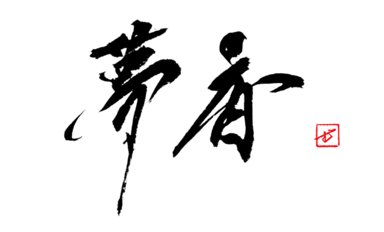
光 Is a Person Carrying Fire Overhead
Most people read 光 (hikari, "light") as a sign for brightness. But trace the old forms and the character is full of movement. In its oracle-bone shape, 光 is a kneeling person with fire held above the head — not light itself, but a person carrying a lamp. The lower half, 儿, is a pair of human legs; the three strokes on top are the flame that sways overhead. If you refuse to stop at "bright" and go back to "someone is bringing the light," the feeling in your hand changes. When I write this character I always picture the back of a single figure walking through the dark, carrying a lamp.
Building the Six Strokes
光 has six strokes — not many, yet the character asks you to fuse two parts with very different temperaments. The top is three strokes opening left and right, a single horizontal runs through the middle, and two strokes stand below as legs. In practice the top three are the first to fall apart: if the dots point in disagreeing directions, the flame overhead looks about to go out. I bring the left vertical straight down first, then set the right dot with a different breath, letting it flick a little. If the two sides are too symmetrical the flame stiffens, so I deliberately change the speed between left and right.
The middle horizontal is the ground line dividing the fire above from the legs below. You will want to draw it thick and strong, but a thick one splits the character in two. I run this stroke thinner and faster than any other. The final 儿 — a left sweep and a right curve — are two legs kicking off the ground. Make the left slightly short and the right a long sweep, as if stepping forward on the right foot, and the whole character begins to move ahead. The detailed stroke order lives on the kanji dictionary page for 光.
Light Stands in the White, Not the Black
The deepest trap in writing light is the belief that brightness equals density. Before my solo show I tried to finish 光 as a single-character work, thickening every line in my eagerness to make the lamp shine. The darker and thicker I made it, the darker the paper became. After nearly thirty discarded sheets I finally saw the order was backwards. Light is not emitted by the black line. It is the white — between the strokes, around the character — that glows. So now I decide the white before I begin: how much space to leave on either side of the flame, how wide a gap to open between the legs. Take the white first, run the line through it, and the same amount of ink reads brighter.
What makes this work is opening the lower half on purpose. Close the two legs of 儿 tightly and the light dams up at the feet. Open them a comfortable width, leave the white between the legs broad, and the white runs like a path from the flame overhead down through the base. That white path is the "light" I am really trying to draw. I've written elsewhere on the white of the paper as material and on line, weight, and white as the foundation in how to write kanji beautifully. 光 concentrates all three into one character, which makes it, for me, an ideal thing to practice. Thin ground line, wide gap between the legs — that alone, and your 光 starts to shine.