ARTICLE
Autumn in the Studio: How the Season Changes Ink and Paper
2026-10-05
I don't notice autumn from a calendar. I notice it from the ink.
At the end of September, the morning after a typhoon, I pick up the brush and something is different. In summer, when I finish one stroke on a half-sheet (35 × 68 cm) and look back a moment later, the ink is still wet. By late September, it's already dry — cleanly, quickly. Once humidity drops into the low forties, this is what happens.
It's a warning of potential failure, too. Ink drying faster means less time for it to settle into the paper fibers. I once didn't notice the shift and kept working at my summer pace. A line I'd intended to be broad came out narrower than expected — the ink had set before the paper had fully absorbed it. Where the rainy season makes ink spread too freely, autumn does the opposite.
What Dry Air Does to Paper and Ink
As a calligrapher, I work with ink, paper, and brush — and all three respond to humidity.
In dry autumn air (40–50% humidity), paper fibers contract. Ink absorbs faster, bleeding less. Lines come out sharper and more precise. In the rainy season (70–80% humidity), the paper carries moisture even before the brush touches it, and ink travels slowly through softened fibers. Bleeding is wider, lines softer at their edges.
Neither is better. They're different conditions that call for different choices.
Autumn paper suits decisive work. A line lands almost exactly as it was made. There's no softening of the edges, no room for the ink to smooth over small hesitations. The trace of the brush is honest. I notice my own uncertainty more clearly in October than in July — which is one reason I tend to use more sheets in autumn practice. The line I'd come to trust in summer needs recalibration.
What I Change in Autumn
Three adjustments, in order of importance.
First, I load more ink onto the brush. In dry air, moisture evaporates from the bristles faster, and a brush that seems full can run dry within a few centimeters. From autumn through winter, I increase the amount of ink I pick up by roughly twenty percent. The physical habit is this: after wiping the tip lightly on the inkstone's edge, I dip once more before lifting — just a brief return to the ink. That extra loading prevents the unexpected dry patches mid-stroke that autumn otherwise produces.
Second, I slow down. When ink sets quickly, moving deliberately lets me read the paper's response as I go. This matters especially at the end of a stroke — the moment of lifting the brush. Rushing that lift in dry air leaves ink scattered oddly at the line's end. A slight pause before lifting lets the brush release cleanly.
Third, I change what I choose to write. Compositions that rely on deliberate bleeding — loading the brush heavily to let ink spread and pool — don't work well in autumn. I keep that kind of work for the humid months. In October, I favor structures where sharp lines and open space carry the work.
The Face of Autumn Calligraphy
The same character written in the rainy season and in October are different objects.
The same ink. The same brush. The same hand. But the paper in June and the paper in October are not the same paper — one holds moisture and gives the ink room to breathe, the other is dry and unforgiving. I don't try to make October look like June.
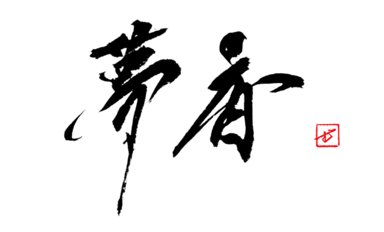
Autumn lines are taut. A little harder. That's what "stillness" — the character 静, sei — looks like when the air is dry.
This is the season I tend to work small. Color paper (27 × 24 cm), narrow tanzaku strips (36 × 6 cm). There's something fitting about the scale: the contracted air, the contained paper, the precise line. Large sheets suit summer and its humidity. Small papers suit October.