ARTICLE
Bleeding Is Not a Mistake — The Dialogue Between Washi and Water
2026-07-14
Why Ink Bleeds
The moment the brush touches washi, ink seeps past the edge of the line. That spreading is nijimi. The cause, in one sentence: the water loaded in the brush travels along the paper's fibers by capillary action, and the ink particles — soot bound in animal glue — ride that water outward. So what decides the size of a bleed is less the darkness of the ink than the balance between how much water is in the brush and how fast the paper drinks it.
When I started, I treated bleeding as a flaw in the paper. A line I thought I had written at the same tone came out crisp one day and blurred the next. I wasted a lot of sheets before I understood that the cause was not my hand but the moisture in the air. Once I saw a bleed as a record of that day's water, the thing I used to erase became something to observe.
The Paper Decides Half of It
Ink, washi, and brush — of the three, the paper governs bleeding most. With the same ink and the same hand, a change of paper makes the line another creature entirely. Hanshi is coarse and drinks fast, so ink swells the instant it lands. Gasenshi holds ink on its surface for a while, and the bleed grows slowly. I mainly use unbleached gasenshi in half-sheets, 35 by 68 centimeters, because its mood as it takes on water is the easiest to read.
Some papers are treated with dosa, a thin sizing of glue and alum that nearly stops the bleeding. I rarely use it. The stilled line is clean, but it looks a little like a specimen. Paper that leaves room to bleed makes the line seem to breathe — and that is not preference but a judgment, given that what I chase is a living line.
Reading the Water
While I grind the ink, the faintly sweet smell of animal glue rises. In the rainy season now the humidity climbs past seventy percent, and the washi has already drunk water from the air. So before the real sheet, I test a single stroke on a scrap of the same paper. From how that one stroke bleeds, I measure whether today's paper is dry or damp. On a damp day I press the base of the brush against paper once to draw off some water before I lower it; on a dry day I do the opposite and load more.
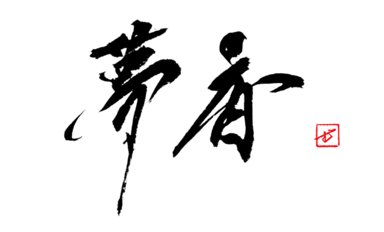
There are failures. The other day I misread the humidity, and the final stroke of the character 無, "nothingness," bled longer than I meant and joined two lines into one. Once, I would have turned that sheet face down. But dry, it showed layers of light and dark inside the merged ink, and the character had gained weight rather than lost it. Bleeding is sometimes a little wiser than the writer's calculation. That is why I no longer discard a bled sheet at once.
If you want the expressive side of bleeding, read The Aesthetics of Nijimi; for humidity and the brush, Calligraphy in the Rainy Season. At my first solo exhibition "Zen" in Azabu-Juban this August, I will show Zen-phrase works born from exactly this dialogue with water.