ARTICLE
Hōge-jaku — What You Put Down Before You Write
2026-07-31
What Hōge-jaku Tells You to Put Down
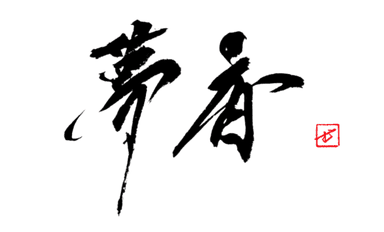
Hōge-jaku (放下著) means: set down what you are carrying, right here, now. It comes from an exchange between Master Zhaozhou and the monk Yanyang. Yanyang said, "I have brought not a single thing — what then?" Zhaozhou answered with just this phrase: put it down. To a man who claims to hold nothing, still: put it down. When Yanyang pressed — "If I am holding nothing, what is there to set down?" — Zhaozhou replied, "Then pick it up and carry it away."
The interesting part is the last character, 著. It carries no meaning of its own; it is a particle that sharpens the command — down with it, now. Even the "I have nothing" you are so sure of: lay that on the ground too. What the phrase pierces is not the thing in your hands but the mind that believes it has already let go. I read it not as advice about discarding baggage, but as the posture I take before I write.
The Seconds Before the Brush Lands
The few minutes of grinding ink are, in fact, my time of hōge-jaku. I drop water into the inkstone, tilt the blue-black stick, and turn it slowly; the slightly heavy scent of animal glue rises. In those seconds I set down, one by one, everything I have carried in with me: the memory that the last sheet went well, the next deadline, the awareness of being watched, the "good shape" my hand has learned to repeat. If I lift the brush without laying these down, the whole line becomes an explanation of them.
A half-sheet — 35 by 68 centimeters of white paper — mirrors whatever you are carrying. Tension shows as thickness, hurry as speed, the wish to look good as ornament in the character. So before the first stroke I hold the brush still, just above the paper, and in that pause I drop the last of the load. On days I manage it, the first stroke is light. On days I don't, it is heavy from the very first point. Calligraphy confesses, in its opening mark, exactly what you walked in carrying. Letting go is not a mood; it is physics, visible in the speed and weight of a line.
The Day I Picked It Back Up
I once kept missing these four characters. Wanting to make "Hōge-jaku" look nobly decisive, I poured a kind of resolve into every stroke. The finished character stood tall — but what sat on the paper was not letting go; it was the assertion of having let go. Exactly as Zhaozhou told Yanyang: I was carrying, all over again, the very strain of insisting I held nothing. Ruined sheets piled on the floor, and that day I never reached the real sheet.
The next morning I put down, first, the wish to write "Hōge-jaku" well. I stopped trying to make the four characters grand and simply wrote them. Force drained out of the final sweep of 著, and the character breathed a little. To write letting-go, you have to first let go of the self that is trying to let go. It sounds circular, but that is what practice is: each time you notice you are carrying something, set it down again. Only that, repeated.
On emptying yourself before you write, I've said more in Calligraphy and Zen; on how to treat the unwritten space, in White Is Not Background. In August 2026 my first solo exhibition "Zen" opens at Palette Gallery in Azabu-Juban, Tokyo, and this Hōge-jaku will hang among the works. August 5 (Wed) – 10 (Mon), admission free. Details on the exhibition page.