ARTICLE
Kaisho, Gyosho, Sosho: Telling the Three Scripts Apart
2026-09-01
Not How Simplified, but How Many Times the Brush Lifts
Most explanations sort the three scripts by degree of simplification: kaisho (block) is precise, gyosho (semi-cursive) loosens it a little, sosho (cursive) loosens it a great deal. That is not wrong. But when I write the three with my own hand, I notice something more physical before I notice the shapes — how many times the brush leaves the paper while I write one character.
Writing the character for "eternity" in block script, my brush lifts from the paper about eight times. Set a dot and lift, pull a horizontal and lift, carry through the air to the next stroke each time. In semi-cursive the lifts drop to two or three. In cursive the brush barely leaves at all, and I sometimes write the whole character in a single pass. So the difference reaches my hand as a count of lifts, before I have thought about form. Speed and continuity both come from here.
Block Stops, Cursive Does Not
Block script stops at every stroke. Enter the brush, carry it, halt at the end — and that stopping puts joints into the line, which is what makes the writing exact and easy to read. Official documents and signboards have always used block script for exactly this reason. It is also why I return to it first thing each morning: each stop lets me check whether my line has gone muddy. Block script cannot be written fast. Write it fast and you skip the places where it should stop.
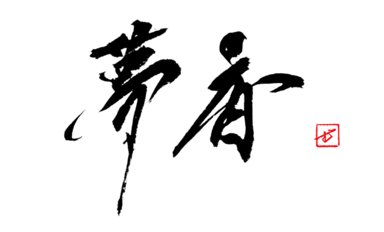
Cursive is the opposite; not stopping is its nature. The brush moves to the next stroke without leaving the paper, strokes are dropped and joined, and a character can change so far it is hard to recognize. So cursive is not "loosened block script." It grew separately, long ago, as a script for speed. It gives up some legibility in exchange for showing the momentum of the ink and the continuity of the line itself. When I write cursive it feels less like writing a character than like pulling one breath. Stop partway and the momentum breaks there, so before I lower the brush I settle my breath and resolve not to halt until the end.
Semi-Cursive Breathes in Between
Semi-cursive sits between the two — stopping, yet not stopping fully. The end of one stroke connects by a thin line into the start of the next, and the number of lifts falls. Because it holds some of the precision of block and some of the speed of cursive, semi-cursive is the closest to daily life. Letters and signatures have mostly been written in it. Legible, and still quick — that balance is, to me, its worth.
When you cannot tell which is which, follow the connections inside a single character with your eyes. If every stroke is separate and clean, it is block. If neighbouring strokes are joined here and there by thin lines, it is semi-cursive. If the joins dominate and the individual strokes dissolve, it is cursive. This way of looking runs straight into why shodo is the act of leaving one breath on the paper: the fewer the lifts, the more a single unbroken stretch of time — one that cannot be redone — is recorded straight into the line.
How I Decide Which Script to Use
Which script I choose for a piece depends on the word. A character I want to show as composed and still — "quiet," say, or "harmony" — I keep in block or semi-cursive, holding the skeleton of the line. A word I want to show as momentum, as a flow of energy in one breath, I lean toward cursive. When someone asks me to write a name, I usually choose semi-cursive: not as stiff as block, not as hard to read as cursive, a balance the person can live with day after day without tiring of it.
The three scripts are not stages of skill or a simple old-to-new order. They are separate vessels, each with its own speed and continuity. Next time you see calligraphy, never mind whether you can read it — follow where the brush leaves the paper and where it joins. In the speed of the line and the way the ink carries on, the breath the writer chose for that one sheet is still there.