ARTICLE
夢 (Yume) — The Character for 'Dream' Is an Eye, an Eyelid, and Night
2026-08-24
夢 Is What You See at Night, Behind Closed Lids
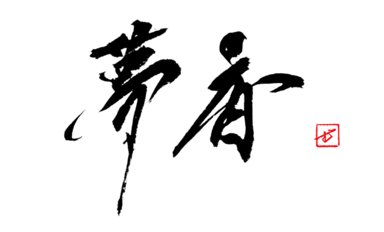
If you write 夢 only as a bright word for hope, the floor drops out of the character. The original 夢 was a person lying down at night, seeing something dimly behind the eyes. In old forms the eye, lashes, and brow are drawn large, set against a bed and 夕, the evening. Something without a clear outline, glimpsed in the dark — that is where 夢 begins. So the character carries, from the start, the quality of a thing that vanishes when you wake. The meaning we reach for now — the dream you chase, the future you want — is a later layer laid over that. A thing that disappears, and a thing you pursue: both live in one character. I think of that doubleness whenever I write it. The feeling of something slipping between your fingers the instant you think you've caught it. Calligraphy is the same — once the ink dries, the speed of the brush and every hesitation are fixed, and no two sheets are ever alike. In trying to hold something passing onto paper, writing and dreaming are close kin.
Building the Thirteen Strokes (艹, 罒, 冖, 夕)
夢 has thirteen strokes, stacked from the top: the grass radical 艹, a sideways eye 罒, the cover 冖, and finally 夕, evening. Four parts piled vertically — a tall character. What collapses easily here is a top too heavy and a base too thin, so the character tips forward. I take the horizontal of 艹 wider than anything else in the character; it becomes the roof that carries the three tiers below. The 罒 below it is split into three by two verticals, but I keep it flat and wide — crowd the verticals in. Push it toward a square and the character swells and chokes at its middle. Keep 冖 short, its two shoulders not too long. And then 夕. The balance of the whole character is decided, in truth, by this final sweep. I pull the left sweep of 夕 a little to the left of the center above it, and a touch longer, so the tall stack is caught underneath and stands without toppling. Which tier to crowd and which to open — the full stroke order lives on the kanji dictionary page for 夢.
Writing a Thing That Fades, So That It Fades
The failure I fall into most here is writing all thirteen strokes evenly, firmly, resolving every one. I once spent a night writing 夢 large on half-size paper (35×68 cm) for an exhibition. The first sheets were so even they read like a blueprint — orderly, yet with no night, no dark, anywhere in them. After a dozen discarded sheets I saw that I had been pressing down to "settle" the final sweep of 夕. But a dream is a dream precisely because it does not settle. From there I stacked the upper three tiers firmly and let the last sweep of 夕 go soft — releasing the pressure, letting the tail thin into a faint dry streak as it left the paper. That trace of dryness at the end finally matched the way an image comes undone at the edge of waking.
夢 is not a character for writing something you can grasp; it holds a passing thing while it passes. So I keep the eye and lids above it clear, but I don't grip the final sweep — I leave the edge of its disappearing. That breath runs straight through the way I see writing itself as a one-time act, which I've written about in calligraphy and impermanence. On the groundwork of stacking strokes so they stand without falling, see how to write kanji beautifully. Wide at the top, flat at the eye, pressure released only in the last sweep — and your 夢 stops being a blueprint, and begins, faintly, to glow in the dark.