ARTICLE
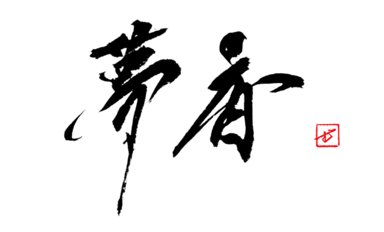
刻 (Koku) — Why 'Carving Time' Uses the Character for a Blade
2026-08-21
The Right Side of 刻 Is a Blade
When you write 刻, don't add the right-hand 刂 lightly, like an ornament. That 刂 is the 刀 ("knife") radical, and those two strokes are a real blade. The left side, 亥, is borrowed for its sound; the character began meaning to cut lines into bone or wood with a knife — the 刻 of "sculpture." To carve is to cut away what you don't need from the material, so that only the shape you want stands up out of it.
So why did a carving character become the 刻 of "the hour," of "a single moment"? Old clocks were water clocks. In the rōkoku (漏刻), the day was measured by how much water had dripped, and the graduations were lines cut into the vessel. Time is really an ungraspable flow, yet people have always divided it with a single line cut by a blade — "up to here." That is why the word "to carve time" still carries the feel of an edge. To mark time, I think, is to set one line that will not vanish into something that keeps flowing away.
Building the Eight Strokes (亥 and 刂)
刻 has eight strokes: six for 亥 on the left, two for the 刂 on the right. The left tends to spread sideways while the right stands thin and tall, so if you're careless the weight topples to the left. For 亥, set a short horizontal and a dot up top, then bring a long sweep down to the left. Lay that sweep too flat and the whole character drifts left, unable to hold up the blade on the right. I draw it at a steeper angle and leave open space at the lower right — preparing a seat for the 刂 before it arrives. The 刂 is two strokes: a short vertical, then, just to its right, a vertical that drives from top to bottom in one pass. That second vertical is the spine of the character. Hesitate and let the pressure drop midway, and the blade goes dull; time no longer cuts. The full stroke order lives on the kanji dictionary page for 刻.
Bring It Down Like Setting an Edge
I hold my breath and pull that long 刂 vertical down in a single motion. One day, writing 刻 as a gift, I tried to make that vertical neat and stopped the brush twice on the way down. The line was tidy, but it had become a line that traced rather than carved — the character for cutting time had turned into a character for stroking it. After a dozen sheets I finally drew it top to bottom without stopping, as if setting a blade into a graduation. Only then did the hard edge of a knife return to those two strokes.
刻 is a character that severs the flowing thing and leaves one line that will not disappear. So sweep the left 亥 softly and bring the right 刂 down hard and sharp. That contrast of soft and hard becomes, exactly, the shape of "cutting time apart." On reading time itself as a single beat, I've written reading ma as time; on what a line carries, what shodo is. Leave space at the lower right with the 亥 sweep, and bring the 刂 vertical down without hesitation — and your 刻 will stop stroking and begin to cut time, cleanly, into one clear division.