ARTICLE
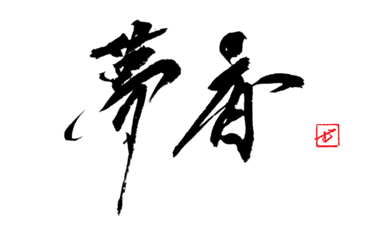
Kanji 霧 (Kiri / Mu): Mist, Rain, and Boundaries That Dissolve
2026-11-19
Kiri — The Word That Closes Distance
霧 carries the kun-reading kiri (mist, fog) and the on-reading mu, found in compounds: 霧中 (muchuu, lost in fog), 濃霧 (nouumu, dense fog), 霧散 (musan, to disperse, vanish). These words share a quality of things becoming invisible or dissolving into nothing.
The sound kiri is short. Mist arrives quickly and leaves quickly. Looking out from the practice space on a November morning, the building that was visible yesterday can be gone — absorbed into white. Distance disappears inside fog. The boundary between sky and ground softens until it no longer exists: the world becomes one flat white field.
Where 澄 (clarity) names the moment excess is removed and transparency returns, 霧 names the reverse — excess arrives and edges dissolve. Both are transformations of visibility, moving in opposite directions.
Rain Crown and Duty — The Character's Construction
霧 contains nineteen strokes and belongs to the rain radical group (雨冠). The lower component is 務 (mu, to attend to duties, to work), eleven strokes.
The rain radical derives from an ancient pictograph: a horizontal cloud line at the top, vertical strokes representing falling water below, with four drop marks inside. 雨冠 appears in characters for natural phenomena that fall from sky or form near it — 霜 (frost), 雪 (snow), 露 (dew), 霰 (sleet). 霧 belongs to this family.
The lower 務 functions primarily as a phonetic element, lending the mu reading to the character. But I find it difficult to fully separate form from sound here. Fog arrives with something that resembles effort: methodical, unhurried, covering each surface in turn. Three thousand years of scribes felt that quality and fixed 雨 and 務 together into this combination.
Writing the Nineteen Strokes
My first concern when writing 霧 is the width of the rain crown.
If 雨冠 extends too wide, the lower 務 is forced into compressed space. The top horizontal stroke of the rain crown sets the character's overall shoulder width. When writing on hansetsu paper (35×68cm), I hold that stroke within the character's intended total width — not wider, not narrower. A breath-width, the character at rest.
The four dot marks inside 雨冠 require careful spacing. Each dot should read as a distinct mark — a short diagonal motion that holds its shape. The vertical energy of the crown enters the character through these four points and spreads laterally. When the dots blur together or run into each other, the crown feels packed and the transition to the lower component loses definition.
The lower 務 is dense with strokes. The left-side movement and the right-side vertical structure need to stay balanced. I keep my gaze toward the right edge of the character before beginning — if I focus only on the left, it tends to run ahead, pulling the whole character off its axis. Left and right breathing together is what makes nineteen strokes cohere.
November Fog and the Practice Space
When fog covers the morning outside the practice window, something changes in the room too. External sound reduces; light diffuses from no single direction; the space feels more enclosed and present.
The white of washi paper is a waiting white — a surface that holds itself ready. Fog is a different white: light that has become material, a white that actively covers. When I write 霧 on foggy mornings, the correspondence between what the character describes and what the air is doing creates a kind of pressure. The character is not abstract.
Fog also changes ink behavior. Higher humidity slows evaporation at the inkstone surface; ink stays workable slightly longer. Lines made on foggy mornings have softer edges than lines made in cold dry air. Whether that is preferable depends on the character — for 霧, whose meaning is exactly that softening of edges, it fits.
Ink and paper and brush in winter fog, writing toward the character that names it.