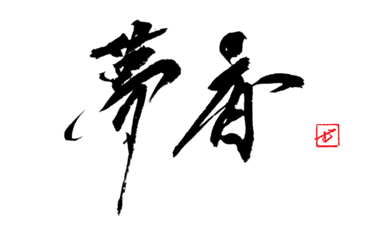
ARTICLE
Writing 文 — The Character That Holds Both Writing and Culture
2026-11-03
The Same Root
Today is Bunka no Hi — Japan's Culture Day, November 3. The word for culture in Japanese is 文化 (bunka), and the word for writing is 文字 (moji). Both begin with the same character: 文 (bun, mon, fumi).
Working with ink and paper and brush every day, this overlap stops feeling like coincidence. Writing is not a tool for transmitting culture from a distance; it is where culture takes form. The act of placing a mark that will not erase — that is what 文 names.
The pictographic origin of 文 is a pattern tattooed on a person's chest. A design inscribed in the body. From that image the character spread toward everything written, named, patterned. At a calligrapher's desk, the lineage is not abstract: when ink enters the fibers of paper, the mark becomes part of the material. There is something in that moment that still feels closer to inscription than impression.
The Structure of 文 in Kaisho
文 has four strokes. Its structure, though, lives in three: the initial horizontal, and the two sweeping strokes that open outward from below the center — a left sweep and a right sweep forming a wide, open triangle.
The difficulty is the balance between them. If both sweeps are equal in length, the character spreads without constraint — open at the base but unstable, nothing holding the weight. Left shorter, right slightly longer. That asymmetry gives the character direction.
For a long time I wrote them the same length. It seemed correct; it looked orderly. But writing thirty characters on a half-sheet — hansetsu, 35 by 68 centimeters — and stepping back, I could see that 文 floated apart from the surrounding characters. The problem was not visible in isolation. Placed in a field of other characters, the equal-length sweeps made it drift. Single-character practice doesn't always reveal what composition practice does.
The difference in entry also matters. The left sweep enters lightly and releases quickly. The right enters with slightly more pressure — I can feel the paper resist briefly — and pulls through more slowly. Because the entry differs, the length follows naturally. The asymmetry does not need to be decided; it emerges from the different quality of motion.
What Gyosho Reveals
After building 文 in kaisho for months, I compared the three script styles — kaisho, gyosho, sosho. In gyosho, the horizontal and the initial downstroke connect, and the sweeps become more fluid. What kaisho enclosed, gyosho releases.
The skeleton becomes more visible in the semi-cursive form, not less. Loosening a structure reveals where its weight actually sits. This is why the eight principles of 永 — learning each stroke type as an independent entity in kaisho — precede any attempt at gyosho. You can only loosen what you first understood as structure.
文 is a short character with few strokes, but it carries the same logic. The kaisho practice accumulates; the gyosho practice draws on it. The two are not separate skills but different depths of the same problem.
Writing 文 on Culture Day is not a special occasion so much as a return to something ordinary. The character is in almost every word that names something written, cultured, or composed. It is background — until practice makes it foreground again.