ARTICLE
Framing a Full Sheet — The Weight of 84 by 160 Centimeters
2026-07-20
The Heavier Part Comes After the Writing
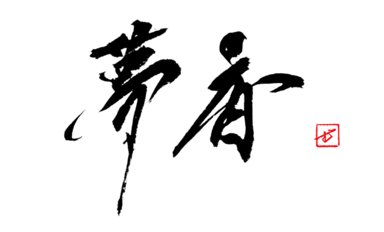
When I finish a full sheet, I sit beside it on the floor for a while, unable to move. While the ink dries, I think about the same thing every time: how do I lift this piece up to the height of a person's eyes. Drawing the line takes seconds; turning it into something I can hand to a wall takes weeks. Preparing large works for a show, I always feel that the framing weighs more than the writing.
Eighty-four by one hundred sixty centimeters — nearly twice the area of a half sheet (35 by 136 centimeters). Rolled, the paper becomes a tube as thick as my forearm. Carrying it to the mounter, the paper is lighter than you would expect. What is heavy is the fact that this single sheet cannot fail. A half sheet I can rewrite tomorrow; a full sheet uses up one whole large piece of paper that smells of animal glue. I hold the brush already thinking about how it will be mounted.
Acrylic, or Bare
The first thing I hesitate over is whether to cover the work with glass or acrylic. Covering protects it from dust and damp. But the more you cover calligraphy, the further it moves from the viewer.
Once I brought a full-sheet work under acrylic into a gallery. Light from the north window reflected off the surface, and standing in front I saw my own faint outline instead of the bleed of the ink. It disappears if you step aside — but making a viewer hunt for the angle where the glare vanishes is, to me, a failure of the mounting. Since then I decide between low-reflection acrylic and framing the piece bare only after seeing the light of the actual wall. The Azabu-Juban gallery has soft north light, so a few pieces this time will go uncovered. Calligraphy paper breathes better touching the air directly.
Choosing a Floating Mount
The other fork is whether to paste the paper to a backing or let it float. For full-sheet works I often choose a floating mount. With a few millimeters of gap between the work and the backing, the slight unevenness of the washi and the faint ridge where the ink has raised along an edge stay visible as the light shifts. Paste it flat and that thickness disappears.
But a floating mount also leaves the paper and the line fully exposed — no backing cloth to reinforce it, nowhere to hide. So the pieces I decide to float change how I leave the white space when I write. How much white to keep inside the frame is something I settle by hanging the work provisionally on the wall during a scouting visit. On mounting choices in general, see Framing and Traditional Mounting; on why I chose this town's light, Why Azabu-Juban.
When the framed full sheet is on the wall and I step back to look up at it, the sheet that was in my hands finally takes the form a stranger can receive. That is what it means to say the heavier part comes after. The mounting is not a decoration added at the end; it begins before the first line. Dates and directions are on the Zen exhibition page.