ARTICLE
The Wrist in Brushwork — Where Arm Power Becomes a Stroke
2026-10-13
Writing about the arm, a gap kept appearing in my account: the wrist. Between the forearm's power and the fingers' fine adjustments, the wrist sits largely unacknowledged. Teachers corrected my arm. They corrected my grip. About the wrist itself, almost nothing was said. Yet the wrist is what translates between the two.
Cursive Script Revealed It
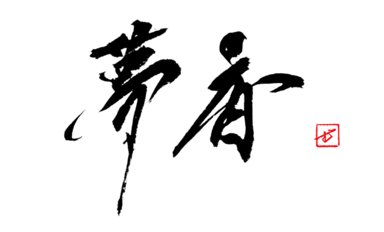
Practicing 草書 (sōsho, cursive script) is where wrist mechanics became impossible to ignore. The connected strokes — where the brush doesn't leave the paper between characters — require directional changes that arm movement alone can't execute cleanly. Writing the character 心 (heart/mind), the transition from horizontal to vertical: when I tried to produce the turning arc purely from the elbow, the stroke broke apart mid-curve.
What I eventually felt: the forearm rotates slightly through the arc, and the wrist amplifies that rotation. When the two movements arrive together, the brush tip runs across the paper with a continuity that neither produces alone.
Copying the Lantingji Xu (蘭亭序) on a half-sheet (35×136 cm), I began to see that Wang Xizhi's fine directional shifts rode on top of larger arm movements. The arm sets the course; the wrist navigates the turns. I tested it deliberately: locked my wrist consciously and wrote a flowing sequence. The strokes collapsed at every direction change. The arc needs the wrist.
What a Locked Wrist Looks Like
Late in a long session, as focus fades, the wrist is one of the first things to tighten. The symptom appears in stroke endings — the brush lifts off the paper at the wrong angle, leaving clipped tails instead of gradual releases. Clean brush movement requires the wrist to participate in the final lift; when rigid, the tip catches.
Tension travels upward. When the grip stiffens, the wrist follows. When the wrist locks, the elbow rises. The way back is through the fingers: exhale, release the grip, and the wrist loosens by itself. Trying to consciously relax only the wrist tends to introduce its own tension.
Two Wrist States
I now use different wrist states depending on the script. For standard script (楷書, kaisho), I keep the wrist stable — the arm's movement should travel directly to the tip without interference. The precision of stroke endings depends on that predictability.
For cursive, the opposite: I consciously increase the wrist's freedom and let it manage the directional changes of connected strokes. The arm's weight sustains the line; the wrist gives it expression. The arm is the vessel; the wrist is what the line says inside it.