ARTICLE
Calligraphy and Incense — How Scent Builds the Time Before Writing
2026-06-14
Why Burn Incense Before Writing
You grind the ink, take up the brush. Absorbed in the motion of your own hands, you forget what kind of space you are sitting in. But the body does not forget. The temperature of the room, the quality of light, the depth of the silence, and the scent in the air — all of it finds its way into the line you draw. Before I begin practice, I always light a single stick of incense. Not to write better, but to raise a small doorway into the time for writing.
Aristocrats of the Heian period burned incense before writing. Less an indulgence than a span of time: as the smoke rose in a thin thread, they settled the breath and carried themselves into the state of writing. In modern terms, scent shifts the mind into another gear. Smell, unlike sight or sound, reaches the parts of the brain that govern emotion and memory almost without detour. So when you repeat the habit of "this scent means it is time to write," the fragrance alone begins to move your hand toward the brush. Incense becomes the switch.
Three Scents I Keep at the Desk
There is no correct incense. But some scents have kept company with the brush across a long history.
Jinkoh, agarwood, runs through all three of the Japanese ways — calligraphy, incense, and tea. It is deep, quiet, and shifting as it burns. Before a large character I usually choose agarwood; it feels as though stray thoughts are peeled away one sheet at a time, and it sits well beside the smell of animal glue in the ink. Byakudan, sandalwood, is warm and gently sweet, and works to loosen a mind wound too tight — before an exhibition, when nerves might show up in the first stroke, I burn sandalwood. The third is not a wood at all but the ink itself. Grind pine-soot ink and a clean, resinous scent of conifer rises off the desk. Using fine ink is, in itself, a fragrance. I wrote about that bluish pine-soot ink in Aoboku and Chaboku.
Do I want to write a cold line today, or a loosened one? By the time I have chosen the incense, half the temperature of the day's writing is already decided — much like choosing the color of the ink.
The Day I Ran Out and Couldn't Write
Once a scent becomes habit, it is only in its absence that you learn how much you leaned on it.
Last year I had run out of agarwood before practice. It is only incense, I thought, and lowered the brush anyway. But every opening stroke came a fraction too early — my hand moved before the breath had fully settled. Sheet after sheet, the lines floated, and that night no piece came out that I could accept. Incense does not make a line good. But it clearly changes the few minutes before the line, and that failure taught me so. The opposite failure exists too: once, wanting to impress a visitor, I burned the incense too strongly, the smell of the ink lost to it, and my hand grew restless. Incense is best kept faint. It should be there only as a presence.
Placing Scent in the Exhibition
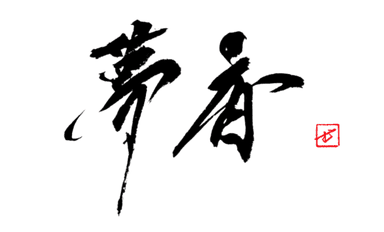
At my first solo exhibition, "Zen", opening this August in Azabu-Juban, I intend to keep incense in the room as well — but it cannot be done the way it is at my desk. In a space where many people come and go, burn too much and the scent speaks before the writing does. So I will keep the agarwood very faint, away from the path of the air, leaving only a presence you might or might not notice. A visitor, partway through looking at a work, suddenly catches the scent, and for that single instant the breath deepens — that amount is the right distance between writing and scent.
I think the same way about sound. Bringing scent and sound into an exhibition of calligraphy is continuous with the empty space — the paper left untouched around the character. The scent, the sound, the silence outside the line are part of it too: I am trying to deliver a single line together with the whole space around it.
Scent Stays in the Line
The writer's state appears in the line. Tension stiffens the stroke; a scattered mind makes the tip waver. But the reverse is true as well: when the space is settled, the body loosens, the breath deepens, and the line extends. Burn incense, make silence, grind the ink slowly — these few minutes before the first stroke may decide half of what lands on the paper.
So you need no incense burner and no rare imported wood. A plain stick of incense, or the steam off a cup of tea beside you, will do. Tie one small promise with your own hands: this scent means it is time to write. Repeat it long enough, and one day the fragrance alone will make you want to take up the brush. Only then is incense no longer an ornament outside the writing, but something dissolved into the line.