ARTICLE
伝 (Tsutae) — Why the Character for 'Transmit' Is Built on a Person
2026-08-20
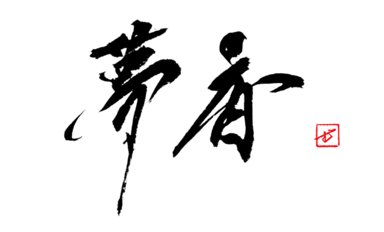
伝 Is a Character for Passing Hand to Hand
If you write 伝 thinking the right side is 云 ("cloud"), you miss the character's core. Its older form is 傳: a person radical on the left, and on the right a hand turning a device for winding thread. It first meant the relay courier and post station — carrying words and cargo on horseback to the next stop. So a person stands at the root of 伝 from the start. Someone receives, someone hands it on to the next: that chain is "to transmit" (伝える); what continues unbroken becomes "tradition" (伝統); what survives passed mouth to mouth becomes "legend" (伝説). When I write this character I do not imagine writing alone. I hold the brush as if I have received it from someone before me and am carrying it one stretch of the way to someone behind me — because calligraphy itself is 伝, three thousand years handed from person to person.
Building the Six Strokes (亻 and 云)
伝 has six strokes: two for the person radical on the left, four for 云 on the right. Few strokes, yet the two sides easily turn away from each other. For the radical, set a short sweep first, then bring the vertical down. Rather than standing that vertical perfectly upright, tilt it a hair to the right so it leans toward the 云 waiting on the other side. The 云 is two horizontals with a ム beneath. The upper horizontal is short, the lower one long — but if you run them parallel the strokes go dead and the character flattens into a plank. I angle the upper horizontal slightly up and keep the lower one nearly level, so the two disagree. The ム is one stroke that sweeps down-left and turns back to the right, plus a dot inside it. Skimp on that final dot and the whole character stays open at the lower right. The dot can be small, but you must place it and close the shape. The full stroke order lives on the kanji dictionary page for 伝.
Don't Let It Split — Write It as One Line
The most common failure here is the radical and the 云 drifting apart like two separate characters. I once spent a day writing 伝 as a single character to accompany someone's work. Each stroke was tidy, yet every sheet split down the middle, and the sense of a word being handed across never appeared. After some thirty discarded sheets I realized I had not carried the breath of the radical's vertical into the entry of the first horizontal on the right. The brush leaves the paper, but the feeling must not. Write as if an invisible line joins the end of the radical to the start of the 云, and the two sides finally become one word.
I think of 伝 as a character made from the very motion of something passing from one hand to the next. So before tidying it, I let it flow: receive at the radical, hand it on with certainty at the 云. On building a beautiful line, I've written how to write kanji beautifully; on what calligraphy carries, what shodo is. Tilt the radical's vertical a hair to the right, and always place that closing dot — and your 伝 will stop splitting and begin, at last, to hand something across.