ARTICLE
道 (Michi) — Why the Character for 'the Way' Carries a Head
2026-08-25
道 Is a Head Deciding Its Direction and Stepping Out
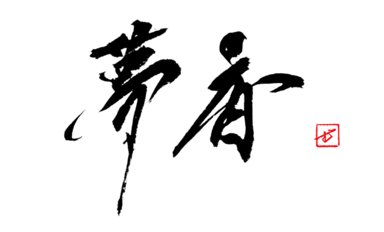
If you write 道 as if it were simply a picture of a road running across the ground, you miss its core. A whole head sits inside this character. The part standing at the top is 首 — a human head, with hair and an eye. Beneath and around it runs 辶, the radical for walking, for advancing. The head comes first; the road follows. So 道 is not a road you happen to travel — it is what appears under your feet the moment a head fixes its direction and takes a step. That is why the character works so cleanly as a metaphor for a way of life. Calligraphy (書道), tea (茶道), the sword (剣道) — every "way" is not the name of a destination but the name of a posture: which direction you keep your head turned as you keep walking. When I write 道, I don't think of a line arriving somewhere. The head looks straight ahead, and 辶 slowly carries the body toward what the head is looking at — the character holds that middle of the journey on a single sheet.
Building the Twelve Strokes (首 and 辶)
道 has twelve strokes: nine for 首 above, three for the 辶 that receives it. By count the head is most of the character, yet what decides the whole impression is that final radical — and there lies the difficulty. Write the head first: two dots and a horizontal make its upper part, and below sits an enclosure close to the shape of 目, an eye. I stand the head's central vertical a little to the right of the sheet, because if I set it dead center there is no room left for the 辶 that will curve in from the lower left. Close the base of the head with one horizontal, then lift the brush. The 辶 comes last of all: a small dot at the upper left, a short fold to the left, and then a long sweep — the 捺 — carried out to the lower right. That last stroke is the platform that bears the weight of the head. Write the head too large and the 辶 cannot hold it, and the character becomes top-heavy; sweep the 辶 too short and the head floats. I always let the end of the sweep pass out to the right of the head's right edge. The full stroke order lives on the kanji dictionary page for 道.
The Radical Carries the Head
The most common failure here is that long sweep buckling into waves. The 辶 is three strokes — dot, fold, sweep — and the final sweep gently changes direction three times within one line. I once spent a day writing the three characters 書の道, "the way of writing." 書 and の would settle, but the 辶 of 道 tensed up midway on every sheet, and a sweep that should have been smooth broke into steps. After nearly thirty discarded sheets I saw the cause: by the time I finished the head, the ink in the brush had run low, and I was unconsciously trying to force it out with pressure. The sweep is not a line you push ink out of. After writing the head, I re-load the brush once, then rest only the weight of the brush on the paper and carry the whole arm slowly to the right. Pull with body weight, not force. From the moment I made that switch, the 辶 became one unbroken line and lifted the head above it with ease.
道 is not two separate things — a head and a road — set side by side. The head decides the direction, and 辶 turns that decision into ground: decision and walking made continuous. So I don't finish the head and the radical as two jobs. I carry the breath of the brush that closed the head's last horizontal straight into the entry of the 辶. Keeping the walking as one unbroken line runs through practice itself. On threading daily practice into a single line, I've written how long it takes to improve; on the groundwork of balancing strokes, how to write kanji beautifully. Stand the head slightly right, and pull the sweep with weight rather than force — and your 道 will stop being top-heavy, and step quietly forward, carrying its head.