ARTICLE
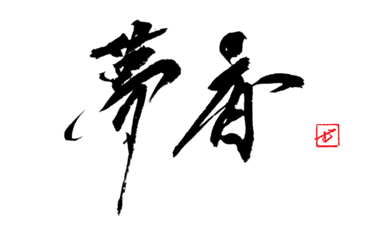
Kanji 風 (Fū / Kaze): When a Phoenix Became Wind
2026-11-05
Two Readings, Two Faces
風 carries two on-readings in Japanese — fū and fu — and two kun-readings — kaze and kaza. The on-readings carry weight and atmosphere: fūkaku (風格, bearing or personal quality), fūryū (風流, refinement), fūkei (風景, scenery). The kun-readings are physical: the touch of autumn air on skin, leaves moving in a courtyard.
Before I write 風, I find myself choosing which voice to call it by. When I say fū silently, the brush moves with something like restraint — looking for quality in each stroke. When I say kaze, the sweeping stroke wants to flow. Neither reading is correct; each shapes what appears on the paper. This is not a technique I read about. It accumulated over ten or more years of daily practice, without my noticing when.
A Phoenix Carrying Air
The character 風 traces further back than its current form suggests. In oracle bone script — the oldest layer of Chinese writing — 風 and 鳳 (hō, the mythological phoenix) were the same character. The ancient world understood wind as the force a great bird creates with its wings. The full arc from pictograph to standard script is covered in from pictograph to kaisho.
By the seal script period, the character changed shape: a phonetic component, 凡 (han), combined with 虫 (chū) — the ancient character for living, moving things. The phoenix became a compound. But the core idea survived: 風 is the force of something invisible in motion. That persistence explains why fūkaku (風格) still names a quality of personal bearing that cannot be pointed at directly — something you feel without being able to explain where it comes from.
The Radical 几 and Its Sweeping Arc
Standard script 風 has nine strokes, organized under the radical 几 (ki). The character wraps an outer frame around an interior 虫.
The difficult stroke is the second: a large leftward sweep that curves inward to enclose the interior. Too shallow, and the character spreads apart without tension. Too deep, and the interior has no room. I spent longer than I expected finding where that sweep ends.
The realization came from writing large. On a half-sheet of paper at 35×68 cm, writing 風 among forty or so characters in a vertical composition, the sweep looked wrong while the character written alone had seemed fine. The end of the stroke was lifting slightly early. I had to adjust my posture — lean forward in seiza to see the angle — and find in my fingers the pressure where the brush naturally wants to stop. What the large brush learns, the small brush inherits. This is the same mechanism that classical copying (rinsho) trains: the body absorbs through repetition what the mind cannot hold by instruction.
What Remains Invisible
When 風 is finished, something accumulates in the strokes that I can feel but not fully name. The angle, pressure, and speed of the sweeping stroke together hold something — not the character's literal meaning, but its quality. The phoenix had become a compound long before I picked up a brush, but the idea it carried — an invisible force moving through the world — still lives in the character's motion.
Writing it well means that force can still pass through.