ARTICLE
Why Is Stroke Order Fixed in Calligraphy?
2026-10-02
The question came after a failure
For ten years after I first held a brush, stroke order was simply memorized. My teacher would demonstrate, I would follow, and the sequence was never questioned. The question came after a failure.
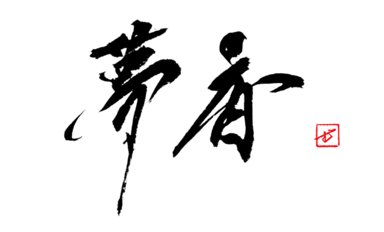
I was writing 春 (spring) on half-sized paper — around 35 × 68 cm — working in large characters. Somewhere in the middle of the component 日, I slipped, starting with the left vertical instead of the horizontal that should come first. I didn't notice until I tried to close the bottom of 日 with a final horizontal. The ink from the vertical hadn't dried. Each time the new stroke crossed it, there was a faint catch — a slight drag where wet met wet. I had been writing in one continuous rush, so there was no chance to wait. That sheet went to the discard pile.
Stroke order breaks down not in theory, but in wet ink on paper.
The three principles are physics
The three rules of stroke order — top to bottom, left to right, horizontal before vertical — did not arrive from convention. They are answers to the physics of brush on paper.
Writing top to bottom keeps the hand from running over wet ink. Each new stroke is always ahead of where ink just landed. Work bottom to top and the side of the hand sweeps through everything placed a moment before, smearing it into the paper. Left to right follows the same logic: a right-handed writer returning left would pass over fresh strokes with each backswing.
Horizontal before vertical is about the skeleton of the character. In most kanji, horizontal strokes form the structural shelves from which verticals hang. Write 土, 王, or 三 with the vertical first, and there is no reference for how long the horizontal needs to be. Put the horizontal down first and the vertical knows where to stop. In the same way that where a radical sits determines the weight of the character, stroke order is a map of how the character is built from its skeleton outward.
When order becomes instinct
Once stroke order becomes physical memory rather than a checklist, approaching an unfamiliar character shifts. I noticed this after working through the eight fundamental strokes of 永. After that practice, a new character no longer looks like a picture to memorize — it reads as a sequence of motions the hand already knows. The structure comes apart into pieces, and the pieces have a natural order.
Stroke order does have flexibility. The character 必 (necessity) currently has five accepted sequences in modern Japanese, none of them wrong. The core principles hold — top before bottom, left before right — but the priority of verticals versus horizontals varies by era and school. When I write 必, I use the sequence that flows into gyosho, the semi-cursive script: a path that connects most naturally when strokes run continuously. Choosing stroke order this way is not ignoring the rules but understanding them well enough to carry them forward into what comes next on the brush.
What understanding adds that memorization doesn't
The difference between someone who has memorized stroke order and someone who understands it shows up when things go wrong. The day after the failed 春, I returned to the same character and began deliberately with the horizontal. The time that took let the previous ink settle, and the crossing strokes ran clean. Because I knew why the horizontal comes first, one correction was enough.
A beautiful line comes from flow rather than from geometry — and flow begins with knowing what the brush does before it lands on any given stroke. Stroke order memorized is a list. Stroke order understood is a map of how the character unfolds. The map stays useful long after specific sequences slip the mind.