ARTICLE
The Beauty Hidden in Spring Kanji: A Calligrapher's Guide to Seasonal Characters
2026-03-15
Introduction: Kanji as Mirrors of the Seasons
Japan's four distinct seasons have shaped its culture in profound ways, and nowhere is this more evident than in the kanji characters associated with each time of year. Every character we use daily carries within it the wisdom and aesthetic sensibility of ancient people who observed nature and etched the passage of seasons into written form.
For a calligrapher, spring holds special significance. It's a season of new beginnings — graduations and entrance ceremonies, meetings and farewells. When the desire to "deliver words" to someone intensifies, the ability to write spring kanji beautifully takes on a deeper meaning.
In this article, I'll explore the origins of representative spring kanji and share calligraphic techniques for expressing each character, from my perspective as calligrapher MUKYO.
春 (Haru) — The Character That Heralds All Beginnings
Origins
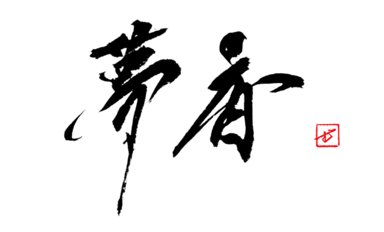
The kanji 春 dates back to oracle bone script. The upper portion, which resembles the characters for "three" and "person," actually depicts plants sprouting from the earth. The lower element 日 represents the sun. In essence, 春 captures the moment when sunlight triggers the simultaneous sprouting of all plant life.
In ancient China, the character also incorporated the phonetic element 屯 (tun), suggesting life force that has been accumulating underground suddenly bursting forth — an explosion of energy.
Calligraphy Tips
When writing 春, I focus most on the rhythm of the horizontal strokes. The three horizontal lines in the upper portion should flow with the lightness of a spring breeze — the first slightly short, the second extending further, the third wider still, like a flower gradually opening.
The 日 at the bottom should be written with solid stability, grounding the character like the earth that supports spring's vitality. Light and airy above, steady and firm below — this contrast gives 春 its life force.
桜 (Sakura) — The Flower of the Japanese Heart
Origins
The traditional form of 桜 is 櫻, combining the tree radical with 嬰 (ei), meaning "necklace." The character 嬰 depicts shells strung together as an ornament. Cherry blossoms clustered densely along branches resembled such a necklace — and so this character was born.
What a beautiful concept. Ancient people looked up at cherry trees in full bloom and saw nature wearing a necklace.
Calligraphy Tips
The modern simplified 桜 has relatively few strokes, which means balance is everything. When writing the tree radical (木偏), position the vertical stroke slightly left and keep it slender, creating space for the right side components ツ and 女.
I pay special attention to ink gradation when writing 桜. Using darker ink for the tree radical and slightly diluted ink for the right side creates a single character that expresses both the strength of the trunk and the delicacy of the petals. This is a technique unique to calligraphy — something no digital font can replicate.
花 (Hana) — A Symbol of Transformation
Origins
花 combines the grass radical with 化 (change). The character 化 depicts a person transforming, changing form. So 花 literally means something in the plant world that changes form — from bud to bloom, from bloom to fruit, capturing the process of transformation itself.
Understanding this etymology adds depth to the phrase "flowers scatter" (花が散る). Scattering is simply another phase of 化 (transformation). Perhaps the Japanese appreciation for the beauty of falling cherry blossoms stems from an unconscious recognition of this essential truth embedded in the kanji.
Calligraphy Tips
The impression of 花 changes dramatically depending on how you write the grass radical. Write it broad and expansive for a dignified feel, or compact for a delicate impression.
In the 化 portion, the space between the left element イ and the right element 匕 is crucial. Wider spacing creates an openness like a flower in bloom, while tighter spacing evokes the concentrated energy of a bud. Choose your approach based on your mood and the person you're writing for.
風 (Kaze) — Writing the Invisible
Origins
Look at the 虫 (insect) inside 風. In ancient China, wind was believed to be caused by invisible creatures — spirits or beings — flying through the sky. The outer frame (几-like shape) represents wind sweeping across the land.
Spring breeze, gentle wind, fragrant wind — Japanese has a wealth of beautiful words for wind. Giving written form to something invisible is the essence of kanji, and of calligraphy itself.
Calligraphy Tips
The outer frame is the most challenging element. Starting from the upper left, drawing right, then sweeping down and flicking left at the bottom — this entire sequence should be written in one continuous breath. If you pause mid-stroke, the flow of wind stops.
The inner 虫 should sit relaxed within the frame. Writing it too tightly robs 風 of its sense of openness. When I write this character, I imagine the wind itself carrying my brush, guiding my arm through the motion.
芽 (Me) — The Fierce Power of Small Life
Origins
芽 combines the grass radical with 牙 (fang/tusk). Fangs seem unrelated to plants, but consider how a sprout forces its way through hard soil — this piercing power is captured through the imagery of 牙.
Have you ever seen a dandelion pushing through a crack in asphalt? That tiny green shoot contains enough life force to break through concrete. The character 芽 condenses that tremendous power — small yet fierce — into a single written form.
Calligraphy Tips
The key to 芽 is balancing the grass radical with 牙. Write the grass radical slightly smaller and give 牙 bold, generous proportions to express the energy of a sprout breaking through the earth.
Extend the final rightward stroke of 牙 with confidence and length. Pour the sprout's direction and momentum into this single stroke. Don't hold back — be bold. Entrust the vigor of new life to your brush.
MUKYO's Perspective: What It Means to Write the Seasons
As a calligrapher, I frequently write seasonal kanji — in performances, commissioned works, and personal practice. Characters that carry seasonal feeling resonate deeply with viewers.
But simply writing the character 春 doesn't breathe life into it. What matters is understanding the origins of each kanji and feeling the season in your body as you write.
Breathe in the spring air. Visualize cherry petals dancing on the wind. Let that image flow through your brush. Something remarkable happens: the character 春 written while actually feeling the spring breeze looks completely different from the same character written in winter.
This is proof that calligraphy is a living art. The writer's body temperature, breathing rhythm, and emotional state are all imprinted on paper through ink — something photography and print cannot convey. In our digital age, I believe the value of this handwritten warmth will only continue to grow.
Closing: Write Your Own Spring Character
Of the five kanji explored here — 春, 桜, 花, 風, and 芽 — if any of their stories moved you, pick up a brush and write it.
You don't need calligraphy supplies. A pen works. Even tracing the character in the air with your finger works. What matters is feeling the meaning of the character as you give it form with your own hand.
Spring is the season of beginnings. If you're going to start something new, now is the time. I hope that the world of calligraphy, beginning with a single character, brings a small beauty into your everyday life.
The MUKYO Calligraphy Journal will continue sharing seasonal kanji columns throughout the year. Stay tuned for the next installment.