ARTICLE
Shodo and the 24 Solar Terms — Capturing the Flow of Seasons in a Single Brushstroke
2026-06-23
Shodo and the 24 Solar Terms — Capturing the Flow of Seasons in a Single Brushstroke
You might not notice it on a modern calendar, but nature is always changing.
The nijushi sekki — the 24 solar terms — is an ancient system originating in China that divides the year into 24 segments, each with its own name: Risshun (Start of Spring), Geshi (Summer Solstice), Tōji (Winter Solstice). Each name distills the essence of a moment in the turning year.
When you practice calligraphy long enough, you start paying attention to this calendar. Because when it comes to choosing what to write, nothing offers richer material than the changing seasons.
Why the 24 Solar Terms and Shodo Belong Together
Calligraphy is the art of capturing "now" through the form of characters.
Given equal technical skill, what you choose to write determines the depth of a work. And this is where the language of the 24 solar terms becomes a powerful guide.
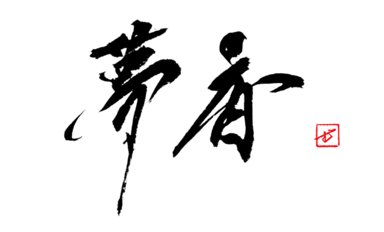
Take the two characters for Geshi — Summer Solstice. 夏至. "The peak of summer." The day when sunlight reaches its greatest intensity, when hours of daylight are at their longest — and the quiet awareness that from here, the days will slowly grow shorter. All of this meaning lives inside two brushstrokes. The question is whether you can bring it to the surface.
The words of the solar terms also carry beautiful sound. Koku-u (Grain Rain). Shōman (Grain Buds). Bōshu (Grain in Ear). Say them aloud as you write, and you'll feel the resonance between sound and brushwork.
Spring Solar Terms and Calligraphy Themes
Risshun — Start of Spring (around February 4)
Winter ends; spring stands up. The air is still cold, but something has shifted. The phrase Risshun Daiki (立春大吉 — Great Fortune at the Start of Spring) has been written in Japan for centuries as an auspicious wish. Written in confident, upright kaisho (block style), it carries the clarity of a new beginning.
Shunbun — Spring Equinox (around March 20)
Day and night in perfect balance. This is a moment of equilibrium, of the middle path. When writing with awareness of this balance, pay attention to the relationship between ink and white space — the negative space becomes as important as the mark itself.
Koku-u — Grain Rain (around April 20)
The rain that nourishes seeds. When writing the character 雨 (ame, rain), visualize the rhythm of falling droplets. You'll find your brushwork naturally softens, growing more gentle and fluid.
Summer Solar Terms and Calligraphy Themes
Geshi — Summer Solstice (around June 21)
The most luminous day of the year. The character 至 (shi) means "to arrive" or "to reach the ultimate point" — there is a quiet tension to standing at an extreme. This is a solar term that calls for bold, sweeping brushwork.
Taisho — Major Heat (around July 22)
The height of summer's heat. Written with heavy, forceful strokes, 大暑 conveys the overwhelming weight of midsummer. Written thin and spare, the same characters suggest longing for coolness within the heat. The same word becomes entirely different depending on how you hold the brush.
Shosho — End of Heat (around August 23)
The moment heat begins to relent. The character 処 (sho) carries meanings of "stopping" and "settling." Written slowly, with measured strokes, it captures the quiet release that comes after the intensity of summer.
Autumn Solar Terms and Calligraphy Themes
Shūbun — Autumn Equinox (around September 23)
Balance again — but this time weighted with harvest and the approach of quiet. The character 実 (mi, fruit or ripening) — a pictograph of a plant bearing fruit — is worth writing slowly, feeling the fullness of the form as your brush traces it.
Sōkō — Frost's Descent (around October 23)
The first frosts arrive. 霜 (shimo, frost) is written with the rain radical above and another character below — rain transforming into white crystals on the ground. Try writing it in pale, diluted ink: the transparency evokes the cold whiteness of frost.
Tōji — Winter Solstice (around December 22)
The longest night of the year. When I write 冬至, I like to leave an unusually wide open space after the characters — letting the white space extend like the long winter night that the words describe. In calligraphy, the blank space is as much a part of the work as the ink.
What It Means to Write the Words of the Seasons
When we write 夏至, 立秋, 霜降, we are not simply transcribing characters.
We are trying to carry something to the paper — the temperature of that day's air, the angle of the light, the smell of the wind. Everything the body perceives, loaded onto the tip of a brush.
Technique is just the means of delivery. The better your technique, the more clearly you can transmit what you've felt. Paying attention to the solar terms trains that capacity to feel.
Practice: Using the Solar Terms as Calligraphy Themes
1. Look up the meaning first Bōshu — Grain in Ear: the time when awns appear on rice plants, and seeds are sown. Knowing this before you write changes everything. The same characters mean something different in your hands.
2. Look at the sky on the day itself Step outside and look up before you sit down to write on a solar term. The light at seasonal turning points has a quality all its own. Carry that moment into the studio, and it will find its way into the work.
3. Choose your script style deliberately Geshi in formal kaisho is austere and crystalline. Geshi in flowing gyōsho has a sense of movement and transition. Let the feeling of the solar term guide your choice of style.
4. Create a yearlong series Write all 24 solar terms over the course of a year. Same paper size, same format. Looking back at the end of the year, you'll see yourself change alongside the seasons — a kind of calligraphic diary of the turning year.
Write Today's Solar Term
Find out which solar term is nearest to today. Write those characters slowly, letting the meaning settle as your brush moves.
Technical skill doesn't matter. What matters is the quality of attention you bring.
When you finish, the air of this season will be there in the work — if you let it.
The 24 solar terms were the language ancient people created to stay in conversation with the natural world. Calligraphy is the practice of making invisible things visible through the form of characters.
When these two meet on a sheet of paper, the whole turning of a season can be held in a single brushstroke.
That's worth experiencing for yourself.