ARTICLE
White Walls and Ink — Calligraphy in the Contemporary Art World
2026-07-01
White Walls and Ink — Calligraphy in the Contemporary Art World
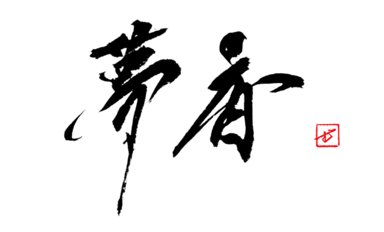
A white gallery wall. A single sheet of washi paper.
There are characters written on it. But you don't need to read them. In fact, the moment you stop trying to read — something else begins to appear.
This is not a traditional calligraphy exhibition. This is the space of contemporary art.
Two Different Questions
The world of calligraphy has deep roots in craft and hierarchy. Gradings, competitions, juried exhibitions — within these systems, calligraphy has long been evaluated on technical precision. Is the brushwork consistent? Is the form faithful to classical models? Is the line quality refined?
That is a legitimate and beautiful standard.
But contemporary art asks a different set of questions.
"Does this work exist nowhere else in the world?" "Does it generate something inside the viewer?" "Can it outlast the moment it was made?"
Not technical precision, but existential force. That is what the white-cube gallery asks of calligraphy.
When the Line Steps Out of Language
In the history of calligraphy, one figure confronted this question head-on.
Inoue Yuichi (1916–1985).
After the Second World War, Inoue set out to dismantle the established frameworks of calligraphy. On large sheets of paper, sometimes using his entire body, he would write single characters — "demon," "fool," "no." But this was not the act of writing a character. The line stood before meaning itself.
Inoue's work was received internationally, and is held in the permanent collection of the Museum of Modern Art (MoMA) in New York. The West embraced it not as "calligraphy" in the traditional sense, but as a dialogue with Abstract Expressionism.
When you stop reading a character, the line becomes pure visual language.
What Ink and Washi Carry Into the Present
Acrylic on canvas. Photograph on photographic paper. Light and space in installation. Contemporary art has expanded into countless materials — and that expansion has sharpened the question: why this material?
Ink and washi paper answer that question with force.
Ink, once placed, cannot be taken back. The irreversibility creates a complete commitment to the instant. Washi absorbs the ink while bleeding and spreading, producing forms that exceed the artist's intent. What happens on the paper is a collision between the artist's will and the material's own nature.
That quality of irreversibility and accident is something contemporary art has long pursued.
What the White Wall Demands
The white gallery wall is not neutral.
The "white cube" is a statement: eliminate all background, show only the work. Pale floors, even lighting, measured wall spacing — it is a space designed to say, "encounter this as art."
To bring calligraphy into that space is to make the same declaration.
And in that space, the question is not technique.
Can this line hold the room?
Does the viewer stop? Does something happen between the line and the person standing before it — wordless, unresolved, present?
When Meaning Dissolves, Line Remains
Calligraphy carries meaning. That is its strength, and also its gravity.
Write "love," and every viewer reads the word. In that instant, the line itself recedes from attention.
In the contemporary art context, calligraphy reaches its fullest power in the moment when meaning dissolves and only line remains. A speed that makes the character unreadable. An intensity that breaks the form. Or a single line surrounded by so much empty space that the silence becomes the subject.
There, for the first time, the viewer is no longer reading characters. They are facing a line.
When Calligraphy Reaches the World
In recent years, work rooted in calligraphy has drawn attention in art markets across Europe, North America, and Asia.
The power of the line crosses language barriers intact. A viewer who cannot read a single Chinese character can still feel the breath within a single stroke. In this sense, calligraphy is no different from music — it carries meaning that language cannot hold.
Calligraphy is a line art before it is a letter art.
When that becomes clear, calligraphy opens itself to the world as a language anyone can receive.
A sheet of washi on a white wall.
No need to read it. Only feel it.
What a line says is older than what a word says — and reaches further.