ARTICLE
Shodo and Sculpture — How a Line Carves Space
2026-06-28
Shodo and Sculpture — How a Line Carves Space
Calligraphy is thought to live on paper.
But anyone who has held a brush knows the truth: when a line is drawn, it doesn't simply move across a flat surface — it moves through space. The sharp entry of the tip meeting washi, the arc of a stroke cutting through air, the weight of ink sinking into fibers — every movement in shodo carries a dimensionality that the eye alone cannot fully see.
Calligraphy and sculpture are not distant arts. They share the same root.
The Sculptural Nature Embedded in Shodo
A sculptor removes material to reveal form within space.
What does a calligrapher do?
When the brush meets washi, the calligrapher carves force into the paper. Strong pressure compresses fibers into the surface; a dry, broken line catches the raised grain and drags across it. The trace left behind holds a depth that goes beyond the visible contrast of black and white.
In shodo, terms like yo-yaku (rise and fall of pressure) describe something physically equivalent to the "relief" of a sculpture — whether a line sinks into the paper or floats across it. Whether it is carved or merely skimmed. Run your fingers across a great piece of calligraphy, and you feel the topography. Shodo was always three-dimensional in origin, a form where touch and sight converge.
Calligraphy Set Free — Three-Dimensional Shodo
From the 2010s onward, artists began questioning whether calligraphy had to remain on paper at all.
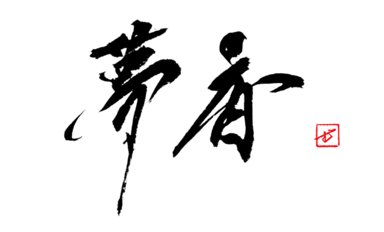
Japanese calligrapher Sisyu (紫舟) liberated the form of characters from the two-dimensional plane entirely, creating sculptures that freeze the motion of brushwork into physical objects. Bamboo, cloth, metal — materials became the support for the energy of a stroke. The result is no longer something you read. It is something your body receives from every direction.
The art collective teamLab developed the concept of "Spatial Calligraphy," reconstructing brushstrokes in three-dimensional light installations shown around the world. The speed, direction, and pressure of the brush — movements that ordinarily vanish in an instant — are made permanent as luminous sculpture in space.
What these works reveal is not a new idea, but an ancient one finally made visible: the dimensionality has always been inside calligraphy. Technology is only now letting us see what was there from the beginning.
A Single Stroke as "Motion Sculpture"
In traditional sculpture, the act of carving disappears. Only the form remains.
Shodo is different.
Inside a single line, the movement of the calligrapher is preserved in its entirety. The angle of entry, the speed of the run, the breath held at the stop — the trajectory becomes the line. Calligraphy is a sculpture of motion. Instead of removing material, the calligrapher carves the movement of the body into the paper's surface.
This is why, when standing before a powerful piece of calligraphy, viewers sense movement in something that is perfectly still. They are pulled back into the moment the line was made. It is the same experience a viewer has before a great sculpture — feeling the force that was sealed into stone.
Carving Space Without Tools
In the world of shodo, ma — the space between and around strokes — is not called empty space. It is called white space, and it is considered as essential as the line itself.
The written line and the unwritten ground compose the work together. Ma is not absence; it is space shaped by the presence of the line.
This is remarkably close to how sculptors think. Brancusi once said that space itself is a material of sculpture. What a calligrapher feels toward washi, and what a sculptor feels toward stone or void, converge on the same instinct: both are shaping something that was previously formless.
The moment a line is drawn, the surrounding white space changes form. The line cuts space; the white space takes on contour. A calligrapher writing a line is simultaneously producing an invisible sculpture in the surrounding negative space.
What the West Learned from the Brush
In the twentieth century, Western avant-garde art looked to Japanese calligraphy and found something it had been searching for.
Franz Kline — one of the towering figures of Abstract Expressionism — encountered an accidentally enlarged projection of a Japanese calligraphy study and was stopped cold. His famous black-and-white paintings followed. The gestural lines of Pollock, the dry marks of Cy Twombly, the graphic tension of Kline — critics have long traced these back to a common source in the energy of the brushed line.
Calligraphy did not reshape Western sculpture so much as its spirit resonated with sculpture's deepest questions: What is a line? What is space? Where does movement live after the hand has lifted? These are questions calligraphy and sculpture have always asked in different languages.
A Single Stroke That Carves Everything
In the end, the question returns to its origin.
The line a calligrapher draws in a single breath does not simply travel across paper. It is the trace of a body moving through space — every ounce of force and intention, carved into the surface in one irreversible moment.
The paper is the record of that movement.
This is why, standing before a truly alive piece of calligraphy, viewers sometimes feel they are allowed to be in that space. That the room has been quietly, invisibly organized around the line. Because a single line, drawn well, does carve the space around it.
Calligraphy and sculpture use different materials and different hands. But the root is the same: using a line to give meaning and force to space that had none before. That is what calligraphy is. That, too, is what sculpture is.