ARTICLE
Where Ink Meets Light — Shodo and the Digital Art Frontier
2026-06-13
Where Ink Meets Light — Shodo and the Digital Art Frontier
For centuries, shodo has existed in the space between paper, ink, and brush.
Yet something new is happening. Projection mapping, motion graphics, and interactive installations are weaving themselves into the fabric of traditional Japanese calligraphy. Around the world, artists are asking what emerges when ink meets light — when a form of art built on irreversible, singular moments encounters technology that can replay, expand, and transform those moments into entire environments.
Is this a betrayal of tradition? Or has shodo's deepest potential simply found its time?
The Line Is Alive
At its heart, shodo is not about characters. It is about the line.
Every stroke carries the weight of a single breath, a specific speed, a precise pressure, an emotion that existed only in that instant. This is something a keyboard can never replicate — a trace of life that only the act of writing by hand can leave behind.
When digital art encounters this living line, something remarkable happens.
In projection mapping, light layers onto the ink, and a frozen brushstroke appears to breathe again. The line that was alive for a split second when it was written expands across an entire room. What shodo alone cannot do — express time — becomes suddenly possible. The work does not merely sit on a wall. It moves.
What Each Art Form Brings
To understand the fusion, it helps to understand what each discipline uniquely offers.
What shodo brings:
- The irreversibility of a single moment — the tension of no erasing
- The irregular beauty that only the human body can produce
- The tactile, physical reality of ink, paper, and bristle
- Centuries of philosophy distilled into every stroke
What digital art brings:
- The freedom to scale across entire architectural spaces
- The ability to manipulate time — slow motion, loops, transformation
- Interactivity and dialogue with the viewer
- Integration with color, light, and sound
Neither is superior. Shodo captures a living instant; digital art expands that instant across space and time. The combination opens territory neither could reach alone.
What Is Actually Happening
In 2026, the fusion of shodo and digital technology is unfolding in concrete and compelling ways.
At the Yamato Museum in Hiroshima, a projection performance called "Genbok" — phantom ink — has drawn wide attention. A calligrapher writes live on stage, and in real time, those strokes are projected across the walls and ceiling of the entire venue. The gallery becomes the artwork. Visitors stand inside the brushstroke.
Media artist Yoichi Ochiai has incorporated calligraphy into spatial installations that blend Japanese tradition with computational aesthetics, bringing shodo into serious contemporary art discourse.
Internationally, Japanese calligraphy-based digital installations are appearing at major art festivals, and the word "SHODO" is gaining recognition in global art conversations far beyond Japan.
The Tools Change. The Way Does Not.
There is something important to name clearly here.
Digital technology is a tool. No matter how sophisticated the projector, no matter how precise the motion graphics, if the underlying brushwork has no life in it, the result is only a demonstration of technique. The technology cannot manufacture what the calligrapher failed to put into the stroke.
As a calligrapher, I find that combining shodo with digital actually raises the stakes. A line projected fifty times its original size shows everything. Whether it is alive or not becomes impossible to hide. Digital art strips away the ability to blend into the background of a modest frame.
This is why the fusion demands more, not less, of the calligrapher.
Calligraphy as Space
Perhaps the most transformative possibility in this fusion is the shift from calligraphy as object to calligraphy as environment.
Traditionally, a calligraphy work hangs on a wall. The viewer stands at a distance and looks at a flat surface. The relationship is one of observation.
Projection mapping and spatial installation change this entirely. The viewer enters the work. They are surrounded by lines, enveloped in the atmosphere of ink. The brushstroke is not something to be seen — it is something to be inside.
This may be one of the most significant transformations in the history of shodo: moving from "viewing calligraphy" to "inhabiting calligraphy."
Protecting the Essence, Not the Form
To those who ask whether merging shodo with digital technology damages the tradition, I offer this:
Tradition means protecting the essence, not preserving the form.
The essence of shodo is pouring life into a single moment. As long as that is not lost, the form of expression can transform without fear. A brushstroke of ink becoming light, becoming space, becoming sound — this is not the end of shodo. It is its expansion.
For a generation raised on screens, a projection mapping installation might be the door that opens onto shodo. Someone captivated by a line of light rippling across a gallery wall might be moved to pick up a brush and a sheet of washi paper. Technology can become the entrance to tradition.
Tools change. Materials change. But the act of pressing life into a line — that has not changed in hundreds of years, and I do not believe it will.
To be a calligrapher in an era when ink meets digital light is to be reminded, again and again, of what was always true.
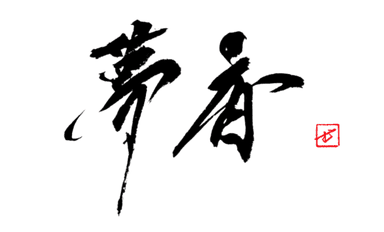
Mukyo — Japanese Calligrapher