ARTICLE
How to Write Beautiful Nengajo: A Calligrapher's Guide to Handwritten New Year Cards
2026-03-24
Introduction — Why Handwritten New Year Cards Still Matter
In an age of instant messaging and digital greetings, the Japanese tradition of nengajo (年賀状) — handwritten New Year postcards — remains one of the most heartfelt ways to express gratitude and warm wishes. Each card, written with brush and ink, carries something no digital message can replicate: the physical presence of the sender's hand, their breath, their intention.
As a calligrapher, I receive more questions about nengajo than almost any other topic. Whether you're a complete beginner or someone looking to elevate your cards, this guide will walk you through everything from choosing the right greeting to mastering brush technique.
Choosing the Right Greeting — Gashi Etiquette
The gashi (賀詞) is the celebratory phrase that headlines your New Year card. Choosing the right one matters — it signals your respect for the recipient.
Four-Character Greetings (Formal)
- 謹賀新年 (Kinga Shinnen) — "Respectfully celebrating the New Year"
- 恭賀新春 (Kyōga Shinshun) — "Reverently celebrating the new spring"
- 敬頌新禧 (Keishō Shinki) — "Respectfully praising the joy of the New Year"
These are appropriate for superiors, mentors, and business contacts — anyone you wish to show deep respect toward.
Two-Character Greetings (Casual to Semi-Formal)
- 迎春 (Geishun) — "Welcoming spring"
- 賀正 (Gashō) — "Celebrating the New Year"
- 初春 (Hatsuharu) — "First spring"
Two-character greetings are best for friends, peers, and casual acquaintances. Using them with superiors may come across as too informal.
MUKYO's Personal Favorite
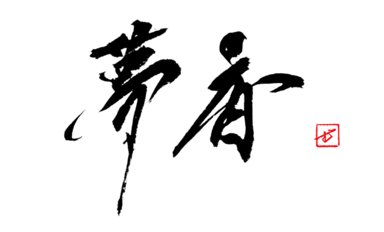
I love writing 寿春 (Jushun) — "celebrating spring." The character 寿 (longevity, celebration) has a beautiful vertical structure that pairs wonderfully with the wide, open strokes of 春 (spring). It's a joy to write and a delight to receive.
Tools — Brush vs. Brush Pen
Traditional Brush and Ink
For the most authentic and expressive results, nothing beats a real brush and sumi ink. The variations in thickness, the subtle gradations of black, the occasional dry-brush texture — these are what make handwritten calligraphy breathtaking.
You'll need:
- A small to medium brush (tip length around 3–4 cm)
- Sumi ink (bottled ink works; hand-ground ink gives richer tones)
- A postcard-sized writing pad for stability
Brush Pens
If traditional tools feel intimidating, a quality brush pen is an excellent alternative. Modern brush pens have come a long way and can produce genuinely beautiful lettering.
Choose based on tip type:
- Brush-hair tip: Closest to a real brush; allows dynamic thick-thin variation
- Felt tip: Stable and predictable; great for beginners
- Hard tip: Writes like a pen; best for fine, controlled text
I recommend starting with a brush-hair tip pen (around $4–8). With practice, you can achieve results remarkably close to traditional brush writing.
Layout — Arranging Your Card Beautifully
For brush calligraphy, vertical writing is the classic and most elegant orientation.
Basic Structure
- Gashi (large, occupying the top third of the card)
- Message (smaller, in the middle section)
- Date (e.g., "Reiwa 8, Gantan" — written small at the bottom)
- Sender's name (at the very bottom or on the reverse)
Layout Tips
- Make the gashi bold and prominent — it's the star of the card
- Keep the message at half the size or smaller than the gashi for visual contrast
- Embrace white space. Just as in calligraphy, empty space gives the characters room to breathe
A Professional Secret
Even as a professional calligrapher, I draw light pencil guidelines before writing my nengajo. A single vertical center line and horizontal markers for each text zone make an enormous difference in the final result. Don't be shy about using them — it's standard practice.
Writing Technique — Five Keys to Beautiful Characters
1. Nail the First Stroke
The impression of any character is shaped by its first stroke. Place the brush on the paper with intention — a gentle press ("ton"), then a smooth pull ("sū"). This rhythmic entry sets the tone for everything that follows.
2. Create Thick-Thin Contrast
Uniform thickness looks flat. Instead, aim for contrast:
- Vertical strokes: slightly thicker
- Horizontal strokes: slightly thinner
- Sweeping strokes (harai): enter thick, exit thin
This dynamic variation is what gives brush writing its life and energy.
3. Vary Character Size
Within a four-character greeting like 謹賀新年, you don't need every character to be identical. Try making 謹 and 新 slightly larger, with 賀 and 年 slightly smaller. This subtle variation creates a natural, flowing rhythm.
4. Use Dark Ink
Nengajo are celebratory, so always use rich, dark ink. Light or diluted ink (usuzumi) is associated with mourning and condolence in Japan — the opposite of what you want on a New Year card. This is an important cultural rule to remember.
5. Add a Personal Note
Beyond the formal greeting, add a short handwritten message: "Thank you for everything this past year," "Wishing you health and happiness," or even just "Let's meet up soon!" A personal touch transforms a card from standard to special.
Common Mistakes and How to Fix Them
Ink Bleeding
If your ink bleeds into the paper, the surface may have moisture or oil on it. Avoid touching the writing area with bare hands, and thoroughly brush away any eraser dust from pencil guidelines before writing.
Crooked Lines
Beyond using guidelines, try aligning your eye level with the edge of the postcard as a visual reference. Also, write one character at a time, pausing to breathe between each. Rushing is the enemy of straight lines.
Making Errors
Mistakes happen to everyone. In Japan, you can exchange miswritten nengajo postcards at the post office for a small fee (about ¥5 per card). So write fearlessly — you have a safety net.
The Value of Handwriting in a Digital World
Nengajo volume has declined year after year in Japan, but this only makes each handwritten card more meaningful, not less. When someone receives a card with real brush strokes, they hold proof that another person sat down, thought of them, and took the time to write.
As a calligrapher, I believe the act of writing carries power far beyond information transfer. When you hold a brush, dip it in ink, and face the paper, you create a moment of mindfulness dedicated entirely to someone else.
Your characters don't need to be perfect. What matters is that they're written with heart. That sincerity always reaches the person on the other end.
Summary
- Match your greeting to the relationship — four characters for formal, two for casual
- Traditional brush is ideal, but a quality brush pen works beautifully too
- Use vertical layout with the greeting large and prominent; embrace white space
- Always use dark ink — light ink signals mourning in Japanese culture
- Draw pencil guidelines — professionals do it too
- Add a personal handwritten note to make each card unique
Start practicing before the season arrives, and you'll feel confident when it's time to write. I occasionally offer nengajo workshops through my calligraphy practice — follow along on this site and social media for announcements.
May your New Year cards bring smiles to everyone who receives them.