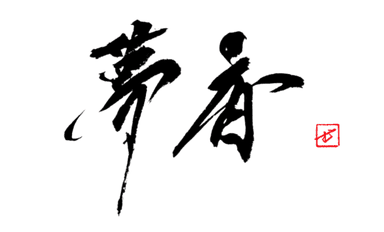
ARTICLE
The Beauty of 'Kasure' in Shodo — The Power Born from Imperfection
2026-05-26
Kasure Is Not a Mistake
When you first begin learning calligraphy, there is a moment almost everyone experiences. You think you've loaded enough ink onto the brush, but the stroke comes out dry and scattered across the paper. Most beginners feel that familiar sinking feeling: "I made a mistake."
But wait.
The longer I (MUKYO) have practiced calligraphy, the more firmly I have come to believe — kasure is not a failure. It is the most honest moment in expression.
Anyone can draw a solid black line with a fully loaded brush. But a kasure stroke cannot lie. The speed of the brush, the pressure applied, the rhythm of the breath, the emotion of that exact moment — all of it is inscribed within those white, scattered flecks.
The Concept of "Feibai" — Flying White
In calligraphy, the intentional use of kasure is called "feibai" (飛白, hiHaku in Japanese), which literally means "flying white."
The concept originated in China during the Later Han dynasty. It describes how ink feathers within a stroke — like a bird taking flight, leaving traces of white air inside the black line. Far from being a mere accident of insufficient ink, feibai came to be understood as a deliberate artistic choice, a signature of mastery.
A feibai stroke carries qualities that a perfectly solid line can never achieve:
- Movement — A sense of speed and momentum lives inside the stroke
- Breath — The rhythm of kasure and connection mirrors the writer's breathing
- Ma (negative space) — The white areas function as "nothingness," making the black line resonate more powerfully
- Vitality — A kasure stroke feels more alive than a perfect one
The Dialogue Between Ink and Paper
Kasure is not created by the calligrapher alone.
Calligraphy is a dialogue between ink and paper. The density of the paper's fibers, the texture of its surface, the humidity in the air — all of these determine how the ink from the brush will react. Even the most skilled calligrapher cannot fully predict or control exactly how kasure will emerge.
That is the fundamental fascination of kasure.
The calligrapher carries an intention — "I want to express this" — and sets the brush in motion. But what line ultimately appears is determined by a complex interaction between ink, paper, air, and the physical state of the body in that moment. The calligrapher does not "create" — they "draw forth."
How a calligrapher accepts this unpredictability is, in a sense, a measure of their artistic maturity.
Alive, Not Perfect
What I seek in my calligraphy is not technical perfection.
The skill to draw uniform, beautiful black lines is, of course, necessary as a foundation. But the question that lies beyond that technique is this: "Is this line alive?"
A kasure stroke answers that question honestly.
Hesitation, tension, release — the inner movement of the calligrapher directly influences where and how kasure appears. That is why a kasure stroke can sometimes reach something deep inside the viewer. Not because of technique, but because the calligrapher's "now" seeps through.
This connects to the Japanese philosophy of wabi-sabi. Just as one finds beauty in a chipped tea bowl, the Japanese have long recognized a profound aesthetic in the imperfect, the incomplete, the transient. Kasure may be the purest expression of wabi-sabi in calligraphy.
How to Intentionally Create Kasure
If you have practiced calligraphy for a while, try working with kasure intentionally.
Ink and Brush Technique
The basic approach to producing kasure is to load less ink and move the brush more quickly. But it is not simply about using less ink.
- Brush speed — The faster you move, the more kasure will emerge
- Varying pressure — Gradually easing the pressure as you write creates a natural gradient of feathering
- Brush angle — Holding the brush more upright creates sharp, crisp kasure; tilting it produces softer, broader feathering
Paper Choice Matters
Even within Japanese calligraphy papers (hanshi), the coarseness of the fibers significantly changes how kasure appears.
- Hanshi (thin paper) — Absorbs ink readily; nijimi (bleeding) and kasure emerge naturally
- Gasenshi (xuan paper) — The textured surface encourages strong, expressive kasure
- Dosa-treated paper — Repels ink slightly, allowing for more controlled kasure
Experimenting with different papers reveals the many faces of kasure.
Kasure in My Own Work
In my own practice and creation, the dialogue with kasure is the thing I value most.
When I stand before a large sheet of paper and write a single line — I cannot fully know in advance where the stroke will feather, where it will reconnect, where it will end. But that is precisely why every piece is a genuine confrontation, and every piece a new discovery.
The white space within a kasure is not simply missing ink. It is evidence that the line was alive — the trace of breath, the mark of tension and release compressed into a single moment.
If a perfect black line "speaks," a kasure stroke "cries out."
What Kasure Teaches About Life
What kasure teaches extends beyond technique.
In everyday life, we are easily trapped by the compulsion to be perfect. We fear failure, avoid vulnerability, and try to live only within what we can fully control.
But calligraphy poses a quiet question: "It is alright to feather. Within that feathering, you exist."
Accepting imperfection. Embracing unpredictability. Entering into dialogue with what cannot be controlled.
A single kasure stroke speaks all of this — softly, but with unmistakable force.
In shodo, kasure is not a technical problem. It is a philosophical question. As you raise your brush for your next stroke, try anticipating not what it will look like — but what it will feel like when the white breaks through.